
table of content
- Introduction
- What is Logistics & Transportation App Development?
- What are the Benefits of Logistics & Transportation Applications for Businesses in 2026?
- What Problems Can Logistics Software Solve?
- What are the advanced technologies used in Logistics App Development?
- What are the Top Logistics Technology Trends in 2026
- Logistics Industry Statistics and Market Trends for 2026
- How Much Does Logistics App Development Cost?
- Why Businesses Choose Custom Logistics Software Development
- What is the Future of Logistics & Transportation App Development?
- Why Choose CodeStore for Logistics App Development?


Logistics & Transportation App Development: A Complete Guide to Features, Benefits, Trends and Costs in 2026
Introduction
What separates industry leaders from the rest in the transportation and logistics in 2026? Increasingly, the answer is technology. As supply chains grow more complex and customer expectations continue to rise, logistics companies are under pressure to deliver faster, operate smarter, and maintain complete visibility across their operations. This is where transportation and logistics app development services are creating a competitive advantage.
From real-time fleet tracking and route optimization to automated workflows and data-driven decision-making, custom logistics applications help businesses reduce operational costs, improve efficiency, and scale with confidence. In this article, we explore how logistics app development is transforming modern transportation businesses and driving long-term growth.
What is Logistics & Transportation App Development?
Logistics applications are software solutions designed to streamline and optimize supply chain and transportation operations. They help businesses manage shipments, track vehicles, monitor inventory, and coordinate workflows from a single platform. By automating routine tasks and providing real-time visibility across the supply chain, these applications improve operational efficiency and decision-making.
Modern logistics apps also enhance communication between stakeholders, reduce delays, minimize costs, and ensure timely deliveries. As logistics networks become more complex, these digital solutions play a vital role in maintaining agility, scalability, and customer satisfaction.
What are the Benefits of Logistics & Transportation Applications for Businesses in 2026?
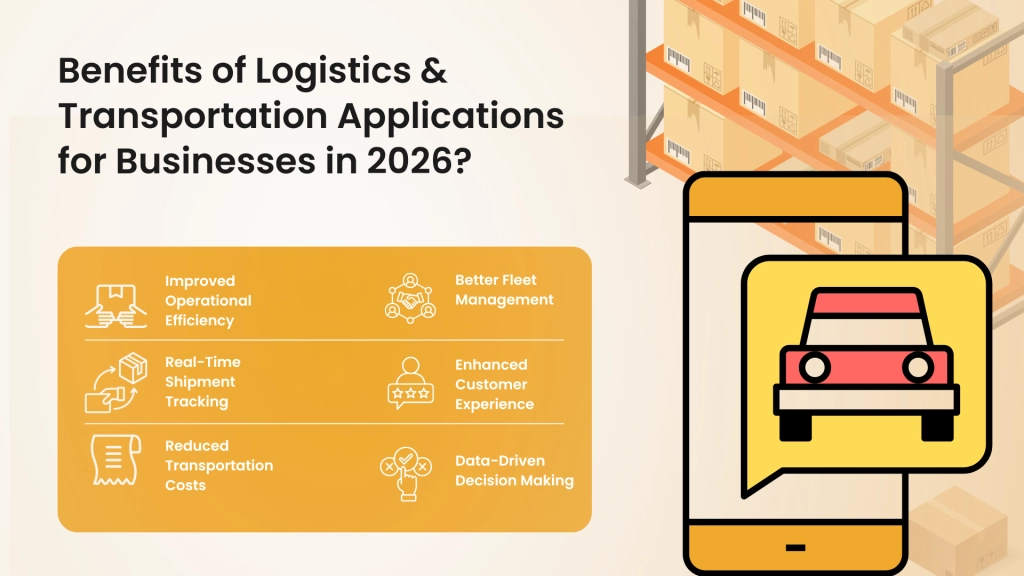
Benefits of Logistics & Transportation Applications for Businesses in 2026?
As transportation and logistics companies embrace digital transformation in 2026, logistics applications are becoming essential for improving efficiency, reducing costs, and enhancing supply chain visibility. Here are the key benefits businesses can achieve through logistics and transportation app development.
- Improved Operational Efficiency: Automates repetitive logistics tasks, streamlines workflows, reduces manual errors, and enables faster execution across transportation and supply chain operations.
- Real-Time Shipment Tracking: Provides live shipment visibility, accurate delivery updates, and proactive issue resolution, helping businesses improve transparency and reliability.
- Reduced Transportation Costs: Optimizes delivery routes, minimizes fuel consumption, reduces idle time, and improves resource utilization to lower operational expenses.
- Better Fleet Management: Monitors vehicle performance, driver activity, maintenance schedules, and route efficiency to maximize fleet productivity and operational control.
- Enhanced Customer Experience: Delivers real-time tracking, automated notifications, and faster deliveries, improving customer satisfaction, trust, and long-term retention.
- Data-Driven Decision Making: Leverages analytics and operational insights to identify bottlenecks, forecast demand, and support smarter business decisions.
- Scalable Business Growth: Supports expanding logistics networks, increasing shipment volumes, and evolving business requirements without compromising efficiency or service quality.
What Problems Can Logistics Software Solve?
Modern logistics software addresses critical supply chain challenges that impact operational efficiency, profitability, and customer satisfaction. By automating processes and providing real-time visibility, businesses can overcome common logistics bottlenecks and improve overall performance.
- Delivery Delays and Route Inefficiencies: Logistics software uses route optimization, GPS tracking, and real-time traffic insights to reduce delivery delays, improve scheduling accuracy, and ensure faster, more reliable transportation operations.
- Lack of Supply Chain Visibility: Provides end-to-end visibility across shipments, warehouses, and transportation networks, enabling businesses to monitor operations in real time and respond proactively to disruptions.
- High Fuel and Operational Costs: Optimizes routes, vehicle utilization, and delivery planning to reduce fuel consumption, minimize unnecessary expenses, and improve overall logistics cost efficiency.
- Inventory Management Challenges: Tracks inventory levels in real time, prevents stock shortages or overstocking, improves warehouse efficiency, and supports accurate demand forecasting.
- Communication Gaps Across Stakeholders: Centralizes communication between suppliers, carriers, warehouse teams, and customers, ensuring seamless collaboration and reducing delays caused by information silos.
- Manual Processes and Human Errors: Automates data entry, reporting, dispatching, and operational workflows, reducing human errors, improving accuracy, and increasing productivity across logistics operations.
What are the advanced technologies used in Logistics App Development?
The future of logistics app development is being shaped by advanced technologies that improve supply chain visibility, operational efficiency, and business decision-making. These innovations are helping transportation and logistics companies build smarter, faster, and more scalable operations.
Artificial Intelligence (AI) in Logistics
Artificial Intelligence in logistics enables route optimization, automated dispatching, intelligent scheduling, and predictive decision-making. AI-powered logistics applications help businesses reduce costs, improve delivery performance, enhance customer experiences, and streamline complex supply chain operations with greater accuracy.
Machine Learning for Demand Forecasting
Machine Learning analyzes historical data, market trends, seasonal patterns, and customer behavior to accurately forecast demand. This helps logistics companies optimize inventory levels, reduce stock shortages, improve resource allocation, and make proactive supply chain planning decisions.
Internet of Things (IoT) for Real-Time Monitoring
IoT-enabled sensors provide real-time visibility into vehicle locations, shipment conditions, inventory movement, and fleet performance. This technology improves supply chain transparency, enhances asset utilization, reduces delays, and enables faster responses to operational disruptions.
Blockchain for Supply Chain Transparency
Blockchain technology creates secure, transparent, and tamper-proof records across the supply chain. It improves traceability, strengthens transaction security, reduces fraud risks, enhances stakeholder trust, and supports regulatory compliance throughout logistics and transportation operations.
Cloud Computing for Scalability
Cloud-based logistics platforms enable businesses to access data, applications, and resources from anywhere. Cloud computing improves scalability, supports seamless integrations, reduces infrastructure costs, enhances collaboration, and allows logistics operations to grow efficiently.
Predictive Analytics for Operational Efficiency
Predictive analytics uses real-time and historical data to identify risks, forecast delays, optimize routes, and improve operational planning. Logistics companies can make data-driven decisions, increase efficiency, reduce disruptions, and enhance overall supply chain performance.
What are the Top Logistics Technology Trends in 2026
The following logistics technology trends in 2026 are helping businesses improve efficiency, visibility, sustainability, and supply chain resilience in an increasingly competitive market.
AI Agents for Logistics Operations
AI agents are transforming logistics operations by automating dispatching, shipment tracking, customer communication, and decision-making processes. These intelligent systems work continuously to optimize workflows, reduce operational bottlenecks, improve responsiveness, and enhance overall transportation and supply chain performance.
Generative AI for Supply Chain Management
Generative AI helps logistics companies analyze complex supply chain data, generate forecasts, automate reporting, and support strategic planning. By providing intelligent recommendations and predictive insights, businesses can improve inventory management, demand planning, and operational efficiency.
Digital Twins in Logistics Networks
Digital twins create virtual replicas of logistics networks, warehouses, fleets, and supply chain operations. Businesses can simulate scenarios, identify inefficiencies, predict disruptions, and optimize processes in real time, enabling better planning, risk management, and resource utilization.
Autonomous Delivery Systems
Autonomous delivery systems, including self-driving vehicles, drones, and robotic delivery solutions, are revolutionizing last-mile logistics. These technologies improve delivery speed, reduce labor dependency, enhance operational efficiency, and help businesses meet growing customer expectations for faster fulfillment.
Sustainable and Green Logistics Solutions
Green logistics solutions focus on reducing carbon emissions, improving fuel efficiency, and supporting environmentally responsible transportation practices. Electric vehicles, smart route optimization, and sustainable supply chain strategies help businesses achieve ESG goals while reducing operational costs.
Hyperautomation in Transportation Management
Hyperautomation combines artificial intelligence, robotic process automation, machine learning, and analytics to automate end-to-end transportation workflows. This approach reduces manual tasks, increases operational accuracy, accelerates decision-making, and enables scalable logistics operations with improved efficiency.
Logistics Industry Statistics and Market Trends for 2026
The logistics and transportation industry is experiencing unprecedented digital transformation in 2026. From AI-powered supply chains to last-mile delivery innovations, market data highlights the growing importance of technology investments in driving operational efficiency, visibility, and business growth.
Logistics Software Market Growth
The global logistics software market was valued at USD 16.24 billion in 2025 and is expected to reach USD 31.74 billion by 2034, growing at a CAGR of 7.75%, driven by increasing demand for supply chain automation, real-time visibility, and transportation management solutions.
AI Adoption in Supply Chain Management
Artificial intelligence adoption is rapidly increasing as organizations leverage AI for demand forecasting, route optimization, predictive maintenance, and inventory management. Businesses are investing in AI-driven supply chain solutions to improve efficiency, reduce operational costs, and enhance decision-making capabilities.
Transportation Technology Investment Trends
Technology investments in logistics are focused on AI, cloud computing, IoT, automation, and advanced analytics. Companies are prioritizing digital transformation initiatives to improve supply chain resilience, optimize transportation networks, and enhance customer experience in increasingly competitive markets.
Fleet Management Software Adoption Rates
The global fleet management software market reached USD 32.36 billion in 2025 and is expected to grow to USD 152.89 billion by 2034 at an 18.9% CAGR, driven by rising adoption of GPS tracking, telematics, route optimization, and fleet analytics solutions.
Last-Mile Delivery Market Growth
The global last-mile delivery market is expected to reach USD 181.58 billion in 2026, up from USD 167.36 billion in 2025, with a projected CAGR of 9.8% through 2033. Growth is driven by eCommerce expansion and rising demand for faster deliveries.
How Much Does Logistics App Development Cost?
Logistics app development costs depend on features, integrations, platform selection, technology stack, security requirements, and overall project scope.
- Cost Based on Features and Complexity: Basic logistics apps cost less, while advanced features like AI, IoT, real-time tracking, and analytics increase development expenses.
- Development Timeline Considerations: Project timelines vary based on feature requirements, customizations, integrations, testing, and deployment complexity, directly impacting development costs.
- Custom vs Off-the-Shelf Logistics Software: Custom logistics software offers flexibility and scalability, while off-the-shelf solutions provide faster deployment with limited customization options.
Why Businesses Choose Custom Logistics Software Development
- Tailored Workflows and Features: Custom logistics software is designed around specific business processes, enabling organizations to streamline operations, improve productivity, and address unique operational requirements effectively.
- Better Integration with Existing Systems: Custom solutions seamlessly integrate with ERP, CRM, warehouse management, and transportation systems, ensuring smooth data flow and enhanced operational visibility.
- Improved Long-Term ROI: Although initial investment may be higher, custom logistics software reduces recurring licensing costs and delivers greater efficiency and scalability over time.
- Competitive Advantage Through Innovation: Custom-built logistics applications enable businesses to implement innovative features, automate processes, and adapt quickly to evolving market demands and customer expectations.
What is the Future of Logistics & Transportation App Development?
Emerging technologies are transforming how businesses manage supply chains, optimize resources, and deliver exceptional customer experiences in an increasingly digital world.
AI-Driven Supply Chains
AI-driven supply chains leverage artificial intelligence, machine learning, and predictive analytics to automate decision-making, forecast demand, optimize routes, and identify potential disruptions. These intelligent systems help logistics companies improve efficiency, reduce costs, enhance visibility, and build more resilient supply chain networks.
Autonomous Transportation Ecosystems
Autonomous transportation ecosystems integrate self-driving vehicles, smart routing technologies, and connected infrastructure to streamline logistics operations. These innovations can reduce human error, improve delivery speed, optimize fuel usage, and create safer, more efficient transportation networks for businesses worldwide.
Smart Warehouses and Connected Logistics
Smart warehouses use IoT devices, robotics, AI-powered automation, and real-time data analytics to optimize inventory management and order fulfillment. Connected logistics platforms enable seamless communication across suppliers, carriers, warehouses, and customers, improving operational efficiency and supply chain visibility.
Sustainable Logistics Technologies
Sustainable logistics technologies focus on reducing carbon emissions, optimizing fuel consumption, and supporting environmentally responsible transportation practices. Electric fleets, green route optimization, and energy-efficient logistics solutions help businesses achieve sustainability goals while lowering operational costs and meeting regulatory requirements.
Why Choose CodeStore for Logistics App Development?
In today’s competitive logistics landscape, businesses need more than just software. They need a technology partner that understands supply chain challenges and delivers measurable results. At CodeStore, we build custom logistics and transportation applications designed to improve operational efficiency, enhance real-time visibility, and accelerate business growth. Our expertise spans fleet management, shipment tracking, route optimization, warehouse management, AI-powered automation, and scalable cloud solutions.
We focus on creating secure, future-ready platforms that integrate seamlessly with your existing systems while adapting to evolving business needs. Whether you’re a logistics provider, transportation company, or supply chain enterprise, CodeStore helps you streamline operations, reduce costs, and gain a competitive edge through innovative logistics software development solutions tailored to your goals.