
table of content
- Introduction
- What is Data Privacy Compliance? Why is it important for Business?
- Benefits of Data Privacy Compliance
- What are the Risks of Ignoring Legal Compliance in Software Development?
- The Evolution of Data Privacy Laws: Past to Present
- What are the Key Data Privacy Regulations Businesses Must Follow?
- Digital Personal Data Protection Act (DPDPA) – India
- General Data Protection Regulation (GDPR) – EU
- Health Insurance Portability and Accountability Act (HIPAA) – US
- ISO 27001 – Global
- Payment Card Industry Data Security Standard (PCI DSS)
- Federal Risk and Authorization Management Program (FedRAMP) – US
- SOC 2 Type 2 – Global
- Federal Information Security Management Act (FISMA) – US
- U.S. state laws
- AI Compliance Laws Businesses Must Understand in 2026
- Data Privacy Compliance Checklist for Businesses
- The Future of Data Privacy Laws: What’s Next?
- Conclusion


What Are the Key Data Privacy Laws Businesses Must Follow in 2026?
Introduction
In 2026, businesses are facing stricter global privacy regulations, growing AI governance requirements, and increasing cybersecurity threats. From GDPR penalties reaching millions to AI-driven data misuse investigations, organizations can no longer treat compliance as optional. Whether handling customer information, healthcare records, financial data, or AI-generated insights, businesses must now comply with evolving global privacy frameworks to avoid legal, financial, and reputational damage.
Data privacy rules are continually expanding, and failing to comply can result in significant financial penalties, lawsuits, and a loss of customer trust. Are you prepared? Laws like the GDPR and India’s DPDPA 2023 require strict data handling procedures. Ignoring them might result in reputational harm and security breaches. This guide helps you easily navigate compliance by breaking down important laws, risks of ignoring compliance, and emerging trends to keep the data compliant. Let’s Explore!
What is Data Privacy Compliance? Why is it important for Business?
Data privacy compliance involves establishing policies and practices that fit with legal requirements regarding the protection of user data. It brings together a business’s desire to collect data and a person’s right to control their data. Compliance is related to legal obligations, but it is also about building user trust, promoting ethical practices, and strengthening consumer relationships. Businesses create trust in the long run by prioritizing data security and ensuring trust in a digital world, where developing a legitimate and defined data management strategy is needed to stay competitive and remain compliant.
Benefits of Data Privacy Compliance:
- Legal Protection & Avoiding Penalties: Staying compliant with laws like GDPR and CCPA is crucial. It helps you dodge those hefty fines, lawsuits, and legal troubles that can drain your finances and limit your business operations.
- Building Customer Trust & Brand Reputation: Safeguarding user data boosts your credibility and customer loyalty. It also shields you from the reputational harm that can come from data breaches, paving the way for long-term success in your business.
- Enhancing Security & Preventing Cyber Threats: Compliance means implementing robust cybersecurity measures, which significantly lowers the chances of data breaches, hacking attempts, and identity theft. This way, you’re keeping both your sensitive business information and your customers’ data safe.
- Ensuring Market Access & Business Expansion: Many industries require compliance certifications to operate in global markets, attract enterprise clients, and meet regulatory demands for partnerships.
- Mitigating Operational Disruptions & Financial Losses: Regulation violations may lead to audits, investigations, and litigation, which may cause operations to lag, legal expenses to increase, and investor confidence to decline.
- Gaining a Competitive Advantage: In an increasingly data-conscious digital environment, software development companies that put a high priority on compliance stand out as reliable service providers, drawing clients, partners, and investors.
What are the Risks of Ignoring Legal Compliance in Software Development?
- Severe Legal Penalties: Non-compliance with data protection laws can result in hefty fines, lawsuits, and even criminal charges, severely impacting a company’s financial stability and operations.
- Cyberattacks and Data Breaches: Ignoring security measures leaves software vulnerable to hackers, leading to unauthorized access, data theft, and loss of sensitive customer and business information.
- Reputation and Customer Trust Loss: A single security breach can erode customer confidence, driving users away from competitors and damaging the company’s brand image beyond repair.
- Financial and Operational Disruptions: Recovering security breaches involves legal costs, compensation claims, and operational downtime, significantly affecting business growth and profitability.
- Business Closure and License Revocation: Failure to comply with industry regulations can lead to revoked licenses, restricted market access, and, in extreme cases, permanent business shutdown.
The Evolution of Data Privacy Laws: Past to Present
India’s stance on data privacy has changed dramatically over the years. In the beginning, data privacy was only loosely governed by the Information Technology (IT) Act, 2000, which was more about cybersecurity than about the protection of personal data. The 2008 amendment imposed stronger provisions that included:
- Section 43A – Held companies liable for negligence in protecting sensitive data.
- Section 72A – Penalized unauthorized disclosure of personal information.
Yet these laws did not specify clear directions regarding user consent, processing limits on data, and enforcement provisions. As companies became increasingly dependent on user information, privacy issues multiplied and resulted in several data breaches. The lack of a separate data protection regime compromised assurance and consumer confidence.
The Evolution of Data Privacy Laws: Past to Present
The Turning Point: Supreme Court Ruling & DPDPA 2023
An important turning point was the 2017 Supreme Court decision (Justice K.S. Puttaswamy case), which acknowledged privacy as a fundamental right. As a result, the Digital Personal Data Protection Act (DPDPA), 2023, was introduced which also serves as the foundation for a stronger legal framework.
Key advancements in DPDPA 2023:
- Stronger Data Rights – Individuals can access, modify, or request the deletion of their data.
- Explicit Consent Requirements – Businesses must obtain clear user consent before collecting data.
- Data Protection Authority (DPA) – An independent regulatory body to oversee compliance and enforce penalties.
- Mandatory Data Breach Reporting – Organizations must report data breaches promptly.
Challenges and Loopholes: Despite its advancements, the DPDPA still faces key challenges:
- Broad Government Oversight – This Act gives the government extensive powers, which raises some concerns about its misuse.
- Compliance Costs – Small and medium enterprises (SMEs) could find it tough to put in place the strict data protection measures required.
- Low Consumer Awareness – A lot of people still don’t know their rights when it comes to data privacy, which really limits the effectiveness of the law.
The DPDPA, 2023 is a big move in the right direction for India’s data privacy, but companies still need to be attentive in making sure they’re in compliance. Furthermore, ongoing enhancements and consumer education initiatives will be essential to ensuring that India’s data privacy legislation is effective.
What are the Key Data Privacy Regulations Businesses Must Follow?
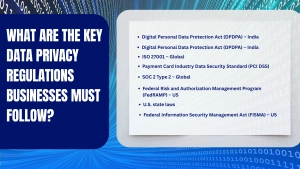
What are the Key Data Privacy Regulations Businesses Must Follow?
Digital Personal Data Protection Act (DPDPA) – India
The Digital Personal Data Protection Act (DPDPA) 2023 is one of India’s most important data privacy regulations introduced to protect how personal information is collected, stored, and used by businesses. The law requires organizations to take user consent before processing personal data and gives individuals greater control over their information, including the right to access, update, or delete it.
For businesses, complying with DPDPA is becoming increasingly important as digital operations continue to grow across industries. It not only helps reduce legal and security risks but also builds customer trust and strengthens brand credibility. The law also applies to companies outside India that handle data of Indian users, making it highly relevant for global businesses, SaaS platforms, healthcare providers, fintech companies, and enterprise software organizations operating in today’s data-driven environment.
General Data Protection Regulation (GDPR) – EU
The General Data Protection Regulation (GDPR) is a major data privacy law introduced by the European Union to regulate how businesses collect, process, and protect personal data. It applies to any company handling data of EU citizens, regardless of location.
GDPR requires businesses to obtain clear user consent, maintain transparent data practices, and provide individuals with rights over their personal information. For businesses working with global customers, GDPR compliance is essential to avoid heavy penalties, strengthen cybersecurity practices, and build long-term customer trust in today’s digital landscape.
Health Insurance Portability and Accountability Act (HIPAA) – US
HIPAA is a U.S. law that governs the privacy and security of health information, specifically in the healthcare industry. For Indian healthcare businesses or any company dealing with U.S. patient data, HIPAA compliance is essential. Key provisions include:
- Privacy Rule: Protects patient information and limits its use to what is necessary for treatment, payment, and healthcare operations.
- Security Rule: Requires healthcare organizations to implement technical safeguards, including encryption, to secure electronic health records (EHR).
- Breach Notification Rule: In case of a data breach, companies must notify affected individuals and relevant authorities within specific time frames.
HIPAA compliance is crucial for healthcare providers, insurers, and business associates in India working with U.S. healthcare organizations to maintain the confidentiality of sensitive health information.
ISO 27001 – Global
ISO/IEC 27001 is an international standard for Information Security Management Systems (ISMS), which provides a systematic way to protect sensitive information. It emphasizes risk analysis, business continuity, and audit compliance to provide data confidentiality, integrity, and availability.
This certification is crucial for companies, particularly IT and finance, that deal with sensitive data and wish to gain the trust of customers and stakeholders. Periodic audits ensure continued compliance, so ISO 27001 is necessary for organizations dedicated to strong data security and regulatory compliance.
Payment Card Industry Data Security Standard (PCI DSS)
PCI DSS targets enterprises that process, store, and transmit credit card information of users with the purpose of preventing security breaches and card fraud. Notable requirements among them are data encryption both on transmission and on storage, limitations on access only to qualified employees, and daily monitoring and system testing of network security issues.
Compliance with PCI DSS is necessary for e-commerce, financial service, or any credit card handling industry businesses. Adherence to these standards contributes to building trust and helps to avoid possible financial loss due to security breaches.
Federal Risk and Authorization Management Program (FedRAMP) – US
FedRAMP is a U.S. government initiative that establishes security requirements for cloud service providers (CSPs) that serve federal agencies. CSPs are required to undergo security reviews, adhere to stringent security baselines, and regularly scan their systems for possible vulnerabilities.
Audits on a regular basis ensure compliance with FedRAMP standards. Indian businesses offering cloud services to U.S. federal institutions must comply with these standards to provide data security and uphold business relationships with federal institutions to ensure trust and consistency with U.S. government regulations.
SOC 2 Type 2 – Global
SOC 2 Type 2 is an accounting standard utilized by technology firms to evaluate the security, availability, processing integrity, confidentiality, and privacy of their systems. It was created by AICPA and emphasizes the effectiveness of controls over a given time frame.
The key areas involve robust security controls to safeguard customer information, maintain privacy and confidentiality, and show operational effectiveness. SOC 2 Type 2 certification is crucial for SaaS and cloud organizations, giving assurances to customers that their confidential information is handled securely and responsibly.
Federal Information Security Management Act (FISMA) – US
The Federal Information Security Management Act (FISMA) mandates U.S. federal agencies and their contractors to put in place strong security controls to safeguard sensitive information. The main provisions involve formulating detailed security plans, employing sophisticated software, and ongoing monitoring and evaluating security procedures.
Indian companies contracted by U.S. federal agencies must abide by FISMA to protect federal data to meet stringent security standards and reduce vulnerabilities. FISMA compliance is required for the purpose of retaining government contracts and data protection.
These data privacy laws make sure that companies all over the world, including Indian businesses, safeguard sensitive information, uphold customer confidence, and abide by international standards. Adherence not only helps lessen the risk of monetary fines but also improves brand image and business security.
U.S. state laws
Several U.S. states are introducing stricter data privacy regulations that directly impact software development companies and digital businesses handling customer data. Laws such as the California Consumer Privacy Act (CCPA), CPRA, Virginia CDPA, and Colorado Privacy Act require businesses to improve transparency, user consent management, and data security practices.
For SaaS platforms, enterprise software providers, and cloud-based businesses, complying with these evolving state laws is becoming essential to reduce legal risks, strengthen cybersecurity frameworks, and maintain customer trust while operating in the growing global digital market.
AI Compliance Laws Businesses Must Understand in 2026
As AI becomes central to modern business operations, companies must now balance innovation with compliance. In 2026, stricter AI and data privacy regulations are reshaping how businesses use customer data, automate workflows, and deploy AI systems while maintaining security, transparency, and customer trust.
EU AI Act
The EU AI Act is one of the first major regulations created specifically for artificial intelligence. It focuses on classifying AI systems based on risk levels and introduces strict rules for high-risk AI applications. Businesses using AI for customer profiling, hiring, financial services, healthcare, or biometric identification must ensure transparency, accountability, and data protection compliance. The law also requires companies to clearly disclose when users are interacting with AI systems such as chatbots or virtual assistants.
AI and Customer Data
AI systems rely heavily on customer data to improve automation and decision-making. However, businesses must ensure that personal information is collected with proper user consent and handled securely. Companies should avoid using sensitive customer data for AI model training without clear authorization. Maintaining transparency about how AI tools process data is becoming increasingly important for GDPR, DPDPA, and global privacy compliance. Secure data storage, encryption, and access controls are now essential for AI-driven businesses.
AI Governance Best Practices
To maintain compliance and reduce risks, businesses should implement strong AI governance frameworks. Some important best practices include:
- Conducting regular AI risk assessments
- Maintaining transparency in AI decision-making
- Monitoring AI systems for bias and security issues
- Implementing data encryption and access controls
- Establishing human oversight for critical AI decisions
- Following privacy-first software development practices
Building responsible AI systems not only helps businesses stay compliant with evolving regulations but also improves operational trust, cybersecurity, and long-term customer confidence.
Data Privacy Compliance Checklist for Businesses
Building a strong data privacy compliance strategy is essential for businesses handling customer, employee, or enterprise data. With growing regulations like GDPR, DPDPA, HIPAA, and AI compliance laws, companies must adopt secure and transparent data management practices to reduce legal risks, improve cybersecurity, and maintain customer trust. Here are the key steps businesses should follow for effective data privacy compliance in 2026:
- Identify Applicable Privacy Laws: Determine which regulations apply to your business based on your location, customer base, and industry. Businesses operating globally may need to comply with GDPR, DPDPA, HIPAA, PCI DSS, or other regional privacy laws.
- Maintain a Data Inventory: Track all personal and sensitive data collected across systems, applications, cloud platforms, and third-party tools to improve visibility and risk management.
- Map Data Flows: Understand how customer data moves between systems, vendors, and departments to identify security gaps and unnecessary data collection practices.
- Implement Consent Management: Ensure proper user consent is collected, stored, and managed across websites, applications, and digital platforms to maintain compliance with modern privacy regulations.
- Strengthen Access Controls & Encryption: Protect sensitive data using role-based access controls, multi-factor authentication, encryption, and secure cloud infrastructure solutions.
- Create Privacy Policies & Compliance Documentation: Develop clear privacy policies, internal governance frameworks, and compliance records to improve transparency and audit readiness.
- Monitor Third-Party Vendors: Ensure external vendors, SaaS providers, and cloud platforms follow proper data protection standards and security practices.
- Establish Breach Response Plans: Create incident response and breach notification processes to minimize operational disruption and comply with reporting requirements.
- Train Employees Regularly: Conduct ongoing cybersecurity and data privacy training to ensure teams understand compliance responsibilities and data handling best practices.
Businesses can also improve compliance by integrating secure SaaS development, AI governance frameworks, cloud security solutions, and enterprise cybersecurity strategies into their digital infrastructure for long-term operational resilience.
The Future of Data Privacy Laws: What’s Next?
As technology continues to develop, compliance with data privacy will be stricter, and companies will need to remain proactive in protecting user data. Regulatory policies will keep evolving to tackle emerging issues in AI, cross-border data flows, and consumer protection.
Key Regulatory Focus Areas
- AI and Machine Learning: New laws will ensure the ethical use of AI, preventing biased algorithms, unauthorized data exploitation, and excessive data collection that may infringe on individual privacy rights.
- Cross-Border Data Transfers: Governments will establish stricter regulations to ensure that personal data transferred across borders complies with local privacy laws and is protected from unauthorized access.
- Enhanced Consumer Rights: Future regulations may introduce stronger rights for consumers, such as clearer data access, improved portability options, and greater transparency in automated decision-making processes.
Global Privacy Trends
- Regulatory Convergence: The adoption of GDPR-like laws such as the CCPA in the U.S., LGPD in Brazil, and DPDPA in India across countries worldwide aims to establish unified privacy standards while tackling local privacy matters.
- Robust Enforcement: The escalation of fines and penalties by regulatory authorities for non-compliance makes it necessary for businesses to establish strong data protection frameworks to mitigate legal and financial threats.
- Consumer Advocacy: As awareness of data privacy issues grows among consumers, they demand stronger regulatory measures and hold businesses responsible for their personal data handling practices.
Future Predictions
- Privacy by Design: Businesses prioritize privacy protection during the initial stages of product and service design. Instead of correcting problems later, they start their processes with privacy protection to meet legal requirements.
- Decentralized Data Models: As blockchain technology advances we may see a shift towards decentralized data storage methods. This approach reduces central storage vulnerabilities and empowers individuals to maintain better control of their personal information.
- Advanced Encryption: Businesses can enhance their security protocols to protect sensitive data during storage and sharing procedures. To defend against modern cyber threats businesses are adopting more complex encryption methods that withstand quantum computer capabilities.
- Privacy Compliance Tools: To ensure compliance with privacy regulations such as GDPR, CCPA, and the DPDP Act businesses will need to use automated consent management tools along with data masking systems and secure storage solutions.
When companies adopt these changes, they prepare their data privacy strategies for future challenges and build consumer confidence while maintaining continuous regulatory conformity.
Conclusion
Data privacy compliance is now required for legal protection, customer trust, and business success; it is no longer an option. Being innovative guarantees long-term success in the face of ever-tougher regulations. Your business can avoid penalties and achieve a competitive edge with strong data protection.
As global privacy regulations and AI governance laws continue evolving, businesses can no longer rely on outdated security and compliance strategies. From GDPR and DPDPA compliance to AI-ready secure infrastructure, organizations need scalable systems designed with privacy, security, and regulatory readiness from the ground up.
CodeStore helps businesses build privacy-first software solutions, secure AI systems, enterprise SaaS platforms, and compliance-ready digital infrastructure tailored for modern regulatory requirements. Whether you’re scaling globally or modernizing internal systems, building compliance into your technology stack today is essential for long-term growth, trust, and operational resilience.