
table of content
- Introduction
- What is Retrieval Augmented Generation (RAG)?
- How Retrieval Augmented Generation Works
- Why Do Enterprises Prefer RAG?
- Guide to RAG Best Practices
- What Are Long Context Window Models?
- Benefits of Long Context Windows
- RAG vs. Long Context: Key Differences
- Why Long Context Windows Don’t Replace RAG
- When Long Context Windows Are the Better Choice
- When Is RAG the Better Choice?
- The Hybrid Approach: Why Enterprises Need Both
- Decision Framework: RAG, Long Context, or Hybrid?
- Conclusion


RAG vs Long Context Windows: Do You Still Need Retrieval?
Introduction
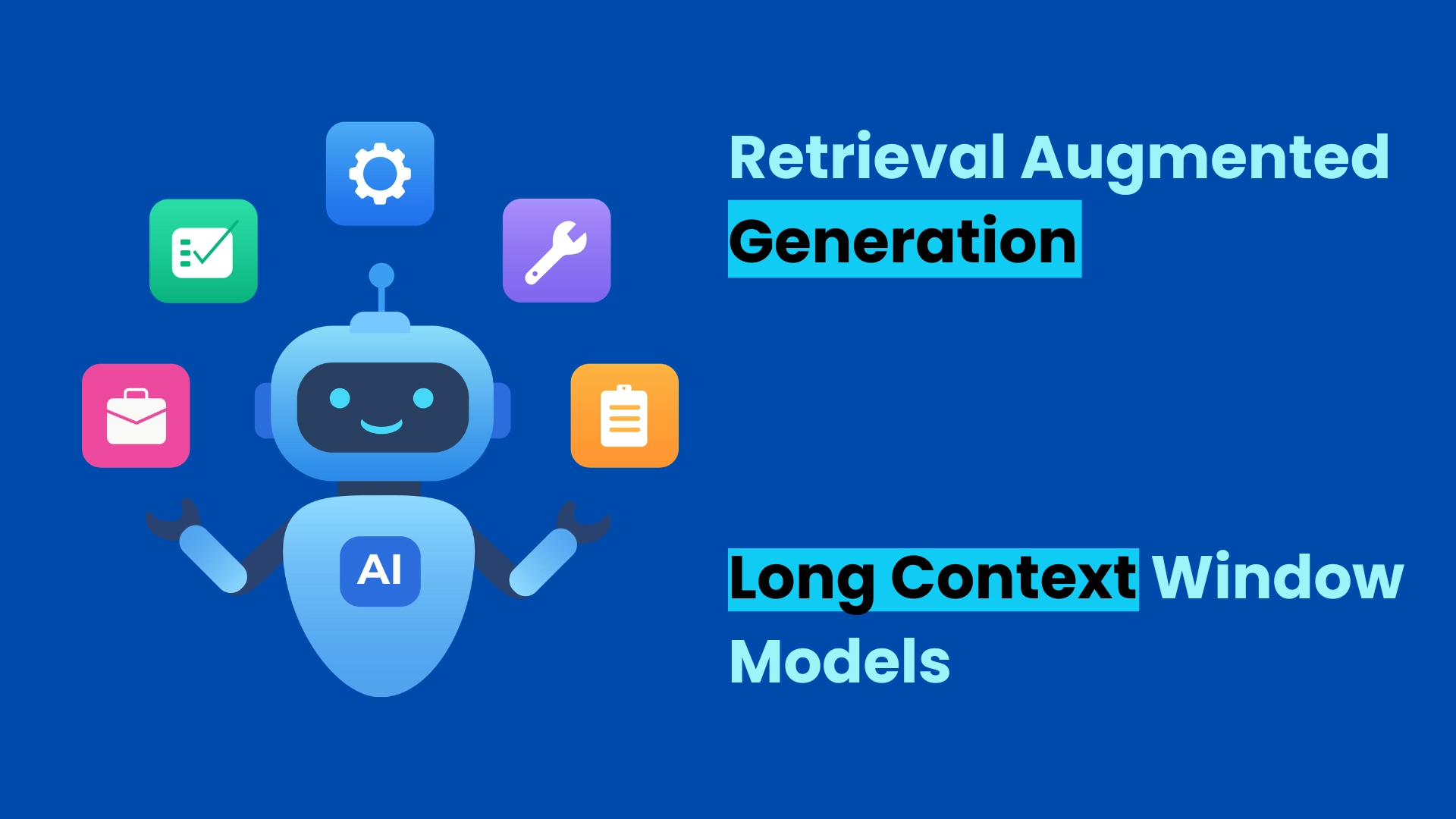
As companies continue to embrace the power of AI, one major question has become increasingly important: Is it better for businesses to implement Retrieval Augmented Generation (RAG) or long context windows?
The rapid development of Large Language Models (LLMs) means that companies now have several options for creating intelligent assistants, knowledge bases, customer service chatbots, and other enterprise-grade search solutions. While long context models can handle large amounts of data in a single prompt, Retrieval Augmented Generation (RAG) takes a different approach: it retrieves only the most relevant pieces of information and then generates a response.
However, choosing the right option is not just about technical features; it significantly affects accuracy, scalability, cost-effectiveness, and user trust. To create truly helpful and efficient AI systems that respond accurately and in context, it is important to understand the pros and cons of each method.
In this guide, we will examine how these technologies work, compare their capabilities, consider real-world use cases, and show how to choose between RAG, long context windows, or a combination of both.
What is Retrieval Augmented Generation (RAG)?
Retrieval-Augmented Generation
RAG stands for Retrieval Augmented Generation; this type of architecture uses both a Large Language Model’s reasoning abilities and an external knowledge base.
Unlike models that rely only on data from previous training sessions, RAG accesses relevant papers, databases, PDF files, or company-specific knowledge before creating a reply. This enables AI systems to use up-to-date, industry-specific, and reliable information when providing answers.
In other words, RAG enables an AI model to “check the Internet” before replying.
How Retrieval Augmented Generation Works
The RAG workflow typically includes the following steps:
- A user submits a query.
- The query is converted into vector embeddings.
- A vector database searches for the most relevant documents.
- Retrieved content is passed to the Large Language Model.
- The model generates an informed, context-rich response.
This architecture reduces hallucinations because it does not depend on the knowledge stored within the model; instead, it uses retrieved information to support its responses.
Why Do Enterprises Prefer RAG?

Why Do Enterprises Prefer RAG?
Companies create millions of documents, reports, SOPs, manuals, policies, and customer files every year. Retraining an LLM every time new information becomes available is neither practical nor efficient. Retrieval of Augmented Generation solves this problem by allowing AI models to access up-to-date information without requiring model retraining. Some typical enterprise use cases are:
- Internal knowledge management
- Customer support automation
- Enterprise document search
- Legal and compliance assistance
- Financial reporting
- Healthcare documentation
- Technical support chatbots
Guide to RAG Best Practices
If you decide to introduce the RAG architecture into your business, adhering to best practices will help achieve better results.
Some recommended RAG best practices include:
- Use high-quality, well-structured data sources.
- Remove duplicate and outdated documents.
- Select an appropriate vector database.
- Optimize chunk sizes for document indexing.
- Continuously evaluate retrieval accuracy.
- Monitor hallucination rates.
- Secure sensitive enterprise data through access controls.
- Update indexed documents regularly.
Following these practices helps organizations build scalable and trustworthy AI systems capable of delivering reliable business outcomes.
What Are Long Context Window Models?
Long Context Window Models
Before comparing both approaches, it is important to understand what Large Language Models are and how long context windows extend their capabilities.
Large Language Models (LLMs) are artificial intelligence programs that learn from huge datasets to understand, produce, summarize, and analyze human language.
It is also important to note that Large Language Models belong to the category of foundation models. Foundation models can process different types of data, such as text, images, audio, and video; however, Large Language Models focus on processing textual content.
A long context window model is a sophisticated Large Language Model that can process much more information in a single prompt. Rather than processing only several thousand tokens, newer models can process hundreds of thousands or even millions of tokens.
This expanded context enables AI systems to:
- Read lengthy research papers
- Analyze legal contracts
- Review technical documentation
- Process financial reports
- Understand long conversations
- Summarize multiple documents simultaneously
Unlike RAG, long context models do not retrieve external information during inference. Instead, they rely entirely on the information provided within the prompt.
Benefits of Long Context Windows
Long context models offer several advantages for businesses:
- Better understanding of long-form documents
- Improved conversation continuity
- Easier implementation without retrieval pipelines
- More natural reasoning across related information
- Reduced engineering complexity for smaller datasets
However, larger context windows also increase computational requirements and token costs, making them less efficient for dynamic enterprise knowledge bases.
RAG vs. Long Context: Key Differences
Long Context Window Models
Although both approaches improve AI performance, they solve different business challenges.
Why Long Context Windows Don’t Replace RAG
With the advent of long context window models, there has been a lot of questioning about whether RAG is still necessary since a Large Language Model can easily consume hundreds of pages in one go through a single prompt.
The truth is that it depends on how enterprise data is generated and managed.
While long context models can process a large amount of text at once, they were not designed to replace knowledge of retrieval systems. Enterprise information is rarely stored in a single document; it is scattered across knowledge management systems, CRMs, policies, emails, product manuals, databases, and cloud storage. Sending all this information in every prompt is impractical.
RAG solves this problem by retrieving only the information necessary to answer the user’s questions. This reduces token consumption, improves response accuracy, and ensures that AI works with the most recent data.
For example, an employee may ask an internal AI assistant about the company’s new leave policy. With a long context model, the current HR handbook would need to be included in the prompt. If it has not been updated, the employee may receive outdated information. With Retrieval Augmented Generation, the most recent policy is retrieved from the company’s knowledge base before the answer is generated.
The cost associated with using only the long context window approach is another drawback. It costs more to process larger prompts because they take many tokens, especially for companies that engage in thousands of interactions through AI daily.
While long context windows are certainly helpful, they do not fully replace retrieval-based approaches. Instead, they work best alongside retrieval to enable deeper reasoning after relevant information has been retrieved.
When Long Context Windows Are the Better Choice
Although RAG offers numerous advantages, there are situations where long context window models provide a more efficient solution.
If your AI application needs to understand a single, lengthy document or analyze information that can fit within the model context window, retrieval may introduce unnecessary complexity. Some ideal use cases include:
Research and Academic Analysis
Researchers often need AI to summarize hundreds of pages of scientific papers or compare multiple research articles. Long context models can process the complete content in one interaction while preserving relationships between different sections.
Contract and Legal Document Review
Legal professionals frequently work with lengthy agreements where understanding clauses across multiple sections is essential. Long context models can review entire contracts and highlight inconsistencies without requiring document retrieval.
Financial Report Analysis
Long context models allow organizations to review annual reports, earnings reports, investor presentations, and other financial disclosures in a single prompt.
Meeting Transcript Summarization
Businesses also use AI to summarize conversations such as internal meetings, customer calls, and webinars. In this case, a long context window makes it possible to summarize the entire conversation rather than isolated fragments.
Codebase Understanding
Developers who have medium-sized projects will be able to benefit from long context models by analyzing several documents at once.
Here, the required information is available in one context, so there is no need for retrieval. Companies can implement the model faster while still using its reasoning capabilities.
When Is RAG the Better Choice?
In most enterprise AI applications, Retrieval Augmented Generation is the optimal solution for businesses that rely on constantly changing data.
RAG comes into its own when accuracy and up-to-date information matter the most.
Enterprise Knowledge Management
Organizations usually store different kinds of information in SharePoint, Confluence, Notion, Google Drive, and internal databases. With RAG, the model does not receive irrelevant information; instead, it retrieves only the documents that matter most.
Automated Customer Support
Support specialists need to constantly update FAQs, troubleshooting guidelines, product documentation, and release notes. With the help of retrieval, users receive responses based on the latest information.
Healthcare and Regulatory Compliance
Medical guidelines, insurance policies, and regulatory compliance requirements often change. In this case, retrieval-based AI systems can access the latest documentation and avoid providing outdated information.
Technical Documentation
IT companies release API changes and different product updates and release notes constantly. Retrieval Augmented Generation allows developers to receive answers based on the latest technical documents.
Enterprise Search
Rather than manually searching through thousands of documents, users can ask natural language questions, and RAG can fetch the most appropriate information for them.
Following RAG best practices, such as using clean data sources, improving retrieval quality, and keeping indexed documents updated, can improve these applications.
The Hybrid Approach: Why Enterprises Need Both
Instead of choosing either RAG or long context windows, many companies choose a hybrid approach that leverages the benefits of both.
The hybrid approach uses Retrieval Augmented Generation to first locate and retrieve relevant documents from the enterprise knowledge base. Those documents are then passed to a long context Large Language Model, which analyzes the retrieved data, identifies relationships across multiple documents, and provides a comprehensive answer.
A hybrid approach provides several business benefits, such as:
- Greater factual correctness due to retrieval.
- Greater ability to reason across complex documents.
- Cost-efficiency since it does not need to send a full knowledge base in terms of tokens.
- Ability to use fresh enterprise information.
- Improved scalability for growing organizations.
- Decreased hallucinations and more reliable AI answers.
For example, a chatbot for customer support can retrieve the freshest product documents, warranties, troubleshooting guides, etc. using RAG. The long context model can summarize all of them in a comprehensive conversational answer.
In addition, lawyers can use RAG to retrieve multiple contracts and compliance documents. And then the long context model will be able to analyze relationships, detect conflicts, and create concise summaries. Enterprise AI development makes hybrid architecture a preferable approach.
<h2id=”tab13″>Business Benefits of Choosing the Right AI Architecture
The choice of the AI architecture is not only the technical one but directly influences the effectiveness of doing business, customers’ experience, costs, and scalability of operations. In any case, whether you will use RAG, long context window, or their mixture, it is crucial to coordinate the AI strategy with the business needs.
These are the main advantages an organization can get from choosing the right solution.
Improved Response Accuracy
The most pressing concern regarding AI systems is guaranteeing the accuracy of the output. The advantage of retrieval-based models is the higher accuracy level resulting from grounding the answers in reliable corporate data sources rather than only using the model’s learned knowledge. This proves to be particularly important in industries such as healthcare, finance, law, and IT.
Lower Operational Costs
Although larger context windows help AI models analyze huge amounts of information, the downside is that they need a lot more tokens, which increases the cost of computation. RAG improves this by only fetching the information necessary for answering the user’s question, thus saving unnecessary token use. Companies that have thousands of AI queries daily can save a lot using such a system.
Faster Access to Enterprise Knowledge
Employees frequently waste time going through documents, emails, knowledge base searches, and internal websites to find what they require. AI enterprise search gives teams the ability to instantly find relevant information in seconds. Rather than manually scanning documents, the system allows individuals to pose queries using natural language and receive answers that are context aware.
Better Customer Experience
Customers want quick, personal, and precise service. By using Retrieval Augmented Generation to construct an AI assistant, it can provide customers with the latest product manual, troubleshooting steps, pricing details, and FAQs, making sure that customers will receive the right and consistent answer.
Scalability for Growing Businesses
An expanding organization would mean the expansion of the knowledge base as well. The addition of new documents should not mean a need for repeated training of a Large Language Model on change of information. RAG provides continuous updates to the knowledge base of organizations without compromising AI accuracy.
Stronger Data Governance and Compliance
Most organizations have compliance issues with the stringent regulatory environment. The retrieval system could be programmed in such a way that it retrieves only authorized documents and follows permission and audit trail principles. Such a high level of control cannot be obtained using large prompt-based models.
Decision Framework: RAG, Long Context, or Hybrid?
Choosing the right architecture depends on your business goals, data availability, and AI use cases. The following framework can help guide your decision.
In practice, there is no one-size-fits-all solution. Businesses should evaluate factors such as:
- How frequently does your data change?
- How large is your document repository?
- Is factual accuracy a top priority?
- What is your expected AI usage volume?
- Do you have strict compliance or security requirements?
- What is your budget for AI infrastructure and token usage?
Answering these questions will help determine whether RAG, long context windows, or a hybrid architecture best aligns with your organization’s needs.
Conclusion
With the development of enterprise AI, companies have a greater number of options to create intelligent, reliable, and scalable AI applications
Long context window models have broadened the capabilities of modern Large Language Models, allowing them to work with lengthy text documents, conduct extended dialogues, and make complex reasoning based on lots of information. Yet they are not meant to substitute retrieval systems.
Retrieval Augmented Generation is the way to go for companies that use dynamic, always-changing data. With RAG, it is possible to increase the precision of responses, reduce hallucinations, save money, and make sure that AI gives reliable answers. As more businesses adopt AI, the companies that pick the right architecture will find themselves in a much better position to become more productive and competitive.
Are you interested in creating an AI solution for your enterprise? Regardless of whether you are considering Retrieval-Augmented Generation, using Large Language Models, or developing an AI architecture that combines both, the right choice can make a difference when it comes to accuracy and efficiency.
Reach out to our AI experts to learn more about the benefits of intelligent and future-proof AI solutions.