
table of content
-
- Does AI Agent really Matter in 2026?
- What Are AI Agents?
- No-Code AI Agent Platforms: Benefits, Tools & Limitations
- Why Businesses choose No-Code AI tools?
- Code-Based AI Agent Frameworks: When to Use Them
- Why Developers Pick Code based Tools
- No-Code vs Code AI Agents: Detailed Comparison
- Real world AI agents use cases for B2B
- Hybrid AI Agent Development: Why It is the Future
- How to Choose Between No-Code and Code for AI Agents
- Future of AI Agents: Trends to Watch in 2026 and Beyond
- Multi-agent systems are the next big thing
- No-code and code tools are blending
- New interoperability standards are making agents work together
- Conclusion: Choosing the Right AI Agent Strategy


No-Code vs Code for AI Agents: Best Approach in 2026
Does AI Agent really Matter in 2026?
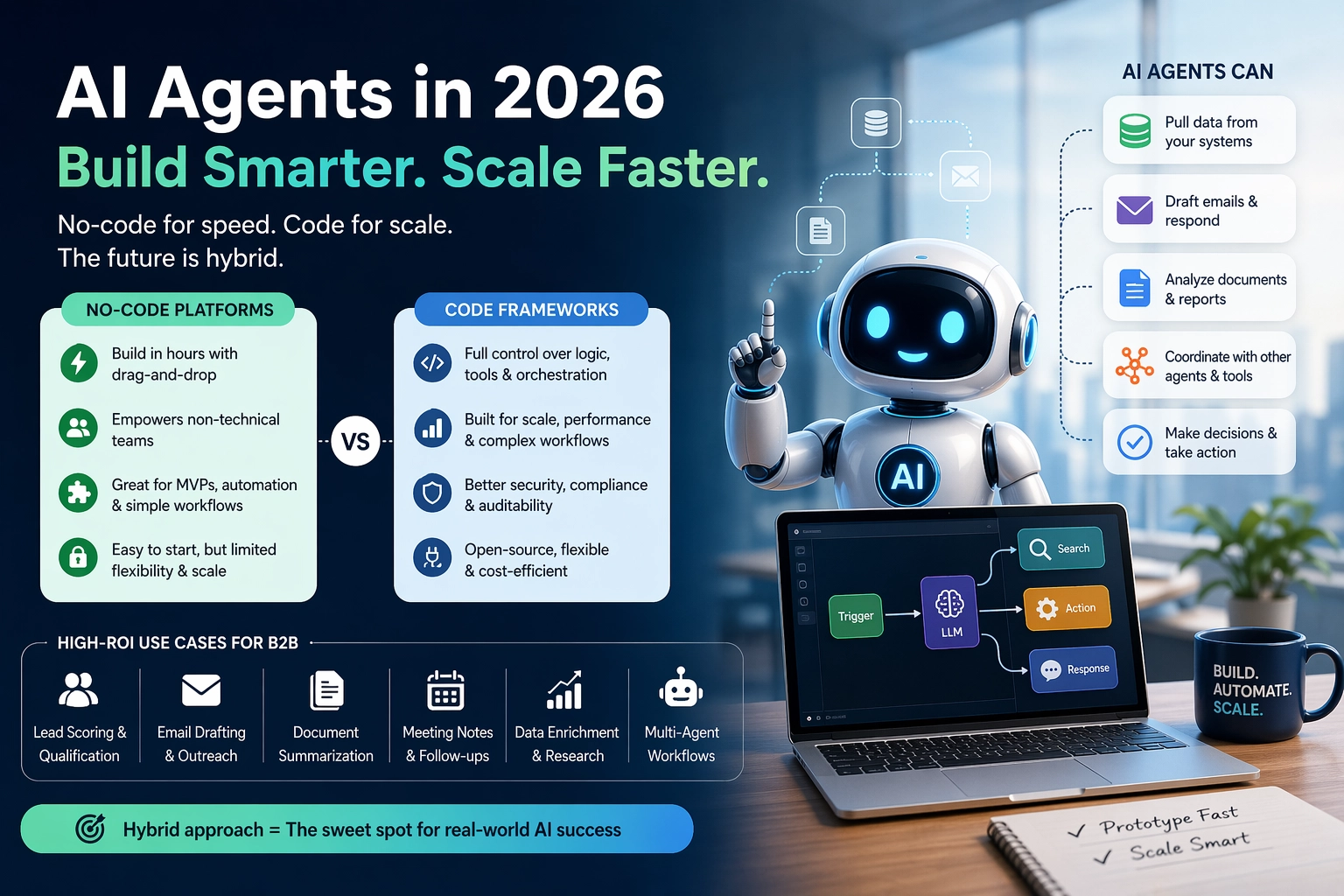
Everyone is talking about AI agents right now. And yes, it is reshaping the enterprise automation. Reason is simple, they can go way beyond chatbots. They can pull data from your CRM, draft emails, analyse documents, and even coordinate with other agents to get complex work done.
The numbers tell a clear story. The global AI agent market is expected to grow from $7.8 billion in 2025 to over $50 billion by 2030, according to MarketsandMarkets. A McKinsey 2025 survey found that 62% of organisations are experimenting with agents. But here is the catch: only 23% have scaled them beyond the pilot stage.
Despite increased adoption, only a limited number of organisations are able to integrate AI agents at scale and achieve measurable ROI for their businesses.
Understanding what drives this gap and how to bridge it, is essential. In the following sections, we explore how to choose the right approach for building scalable and production-ready AI agents.
No-Code vs Code for AI Agents
What Are AI Agents?
Think of an AI agent as a smart worker that does not just answer questions but also do things. It can break a task into steps, pick the right tools, act, review, and adjust. All without you holding its hand through each step.
The research behind this is solid. The ReAct paper by Yao et al. (2022) introduced the Thought, Action, Observation loop that almost every modern agent framework uses today. Microsoft Research's AutoGen paper (Wu et al., 2023) showed how multiple agents can talk to each other and collaborate on tasks. And Stanford's Generative Agents paper (Park et al., 2023) proved that agents with memory and planning can produce surprisingly human-like behaviour.
On the business side, the LangChain 2026 State of Agent Engineering report surveyed over 1,300 professionals and found that 57% of organisations now have agents running in production. That is up from 51% the year before. Customer service and research are the top use cases. The question has shifted from "should we build agents?" to "how should we build them?"
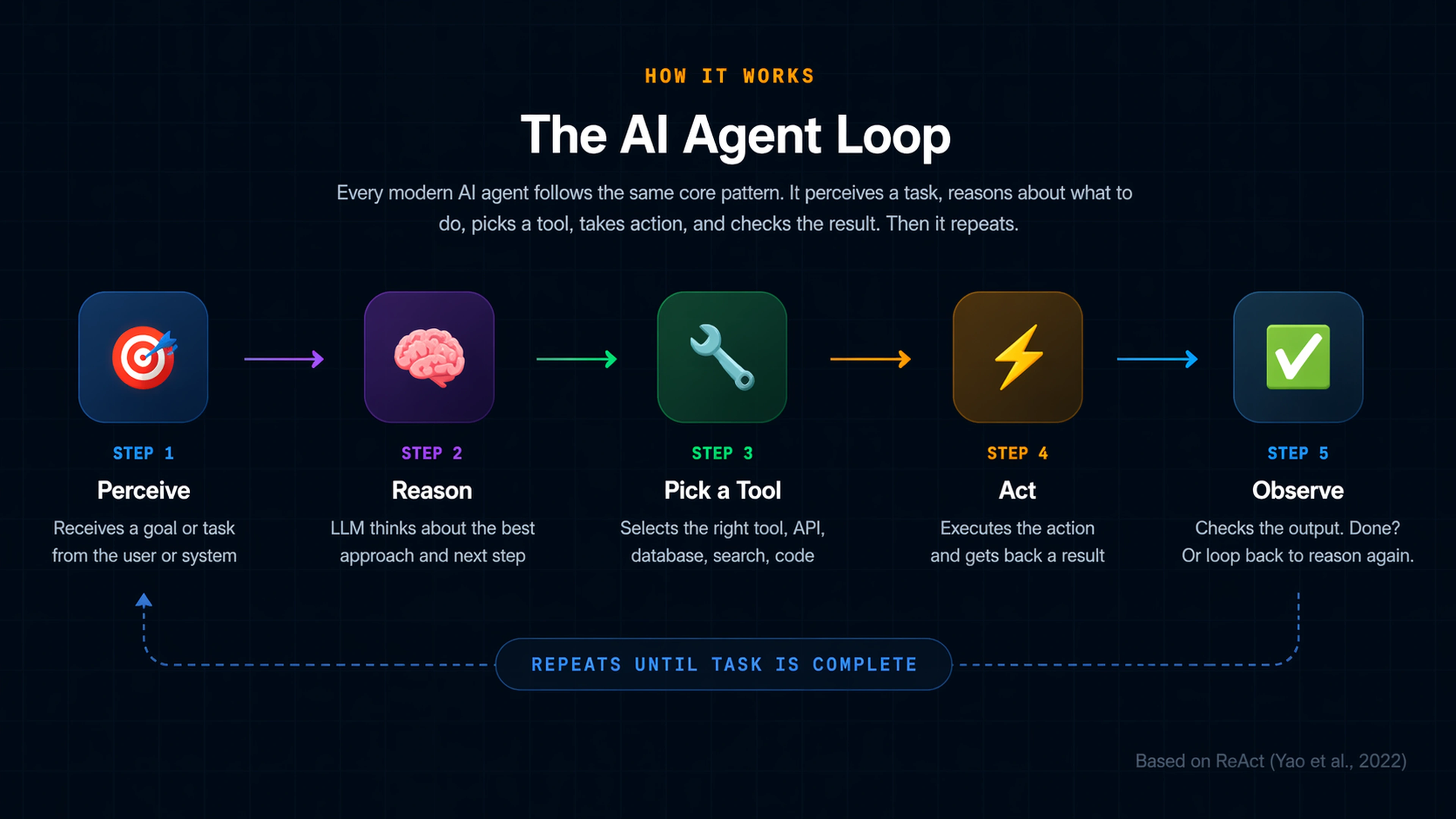
The AI Agent Loop
No-Code AI Agent Platforms: Benefits, Tools & Limitations
No-code platforms let you build AI agents by dragging and dropping components, connecting blocks, and configuring settings instead of writing code. Here are six best no-code AI agent platforms for enterprise:
- Zapier: The largest integration ecosystem with 7,000+ app connectors. Now includes AI Agents and AI Actions to chain LLM-powered steps across apps. But, its pricing can become expensive at scale depending on usage.
- Make (formerly Integromat): It offers a powerful visual workflow builder with routers, filters, and iterators. Generally, it is more cost-efficient than Zapier, especially for complex or high-volume workflows.
- N8n: It is open source and self-hostable. It provides both drag and drop workflows and the ability to write custom JavaScript or Python. It is a strong hybrid tool for flexibility and control.
- Langflow: It is a Python-native visual builder designed for LangChain-based applications. Each visual component maps directly to editable code. It is acked by DataStax and widely used for building and experimenting with LLM workflows.
- Flowise: It is an open source, Node.js based visual builder for creating LLM apps and agents. It focusses on simplicity and quick deployment of AI workflows with a drag and drop interface.
- Relevance AI: A fast growing no-code AI agent platform focused on business workflows and automation. It provides tools to build, deploy, and manage AI agents with minimal technical effort.
- MindStudio: It is built specifically for AI agents rather than general automation. It offers a wide range of model integrations and tools for creating AI-driven workflows, though still evolving as a platform.
Why Businesses choose No-Code AI tools?
You can go from idea to working prototype in hours instead of weeks. Non-developers can build and iterate. The logic is visible as a diagram. And most platforms have free tiers to start with.
But the trade-offs show up fast. Vendor lock-in is a real problem. Zapier's own research found that 74% of stalled AI projects blame dependence on narrow, proprietary tools. Scalability also becomes an issue. ZenML testing showed Langflow hitting 10 to 15 second delays and 100% CPU usage under heavy load. Debugging gets painful as visual canvases grow complex. And if you are in a regulated industry, hosted SaaS platforms may not meet your compliance needs.
Where no-code works best: MVPs and prototypes, internal organizational tools, simple chatbots and FAQ assistants, routine automation like CRM updates or email drafting, content creation pipelines, and data enrichment tasks.
Code-Based AI Agent Frameworks: When to Use Them
Code-based frameworks need developers (mostly Python) but they give you the kind of control and scale that no-code simply cannot match. Six frameworks define this space today:
- LangChain / LangGraph: These are one of the most widely adopted ecosystems for building LLM applications. LangChain provides modular components for chaining LLM calls, while LangGraph adds graph-based orchestration with support for stateful, long-running agents, human in the loop workflows, and better production reliability. Both are widely used across startups and enterprises.
- LlamaIndex: It is designed for data-heavy applications and retrieval-augmented generation (RAG). It excels at connecting LLMs with structured and unstructured data sources. Tools like LlamaParse support multiple file formats which makes it strong for document-heavy use cases.
- CrewAI: It focus on multi agent systems using a role-based approach (e.g., researcher, writer, analyst). CrewAI is easy to get started with for simulating collaborative AI workflows.
- AutoGen by Microsoft: A powerful framework for multi-agent conversations and coordination. It enables agents to interact, plan, and solve tasks collaboratively. Now closely aligned with Microsoft's broader AI ecosystem, including Semantic Kernel.
- OpenAI Agents SDK: A lightweight and structured framework for building agents using core primitives like Agents, Tools, Guardrails, and Handoffs. It is designed for simplicity and tight integration with OpenAI models and APIs.
Why Developers Pick Code based Tools
Total control over reasoning, tools, and orchestration. About 55% lower cost per agent at scale. Open-source licensing (MIT/Apache) means zero vendor lock-in. 68% of production AI agents run on open-source frameworks according to the Linux Foundation. Plus, you get native integration with vector databases, cloud infrastructure, and new standards like MCP and A2A.
The downsides are obvious too. It takes longer to get started. Days or weeks instead of hours. You need skilled engineers who know Python and these frameworks. The upfront people cost is higher. And you are on the hook for infrastructure, deployment, and monitoring that SaaS platforms handle for you.
Where code works best: Complex multi-agent systems, large-scale RAG serving thousands of users, real-time streaming applications, custom reasoning pipelines, regulated industries that need audit trails, and systems where you need tight control over performance.
No-Code vs Code AI Agents: Detailed Comparison
Real world AI agents use cases for B2B
- Klarna (Code): They built an AI assistant for customer support that now handles a significant portion of their customer conversations. It reduced resolution time drastically and operates at a scale that would otherwise require a large support team. This is a strong example of what code-based systems can achieve when built for production.
- C.H. Robinson (Code): The logistics company uses AI systems to automate thousands of daily orders. By integrating agent-based workflows, they have reduced manual effort and improved operational efficiency at scale. This is a classic case where code-first architecture makes a difference.
- Esusu (No-Code): This fintech company used Zendesk's AI tools to automate a large portion of their customer support emails. They improved response times and customer satisfaction without needing a large engineering investment. A good example of how no-code can deliver quick wins.
The pattern across all these examples is consistent. No-code gives you speed for well-defined tasks. Code gives you the muscle for scale and complexity. And the most successful companies often start with a no-code pilot to prove value, then move critical parts to code for production.
Hybrid AI Agent Development: Why It is the Future
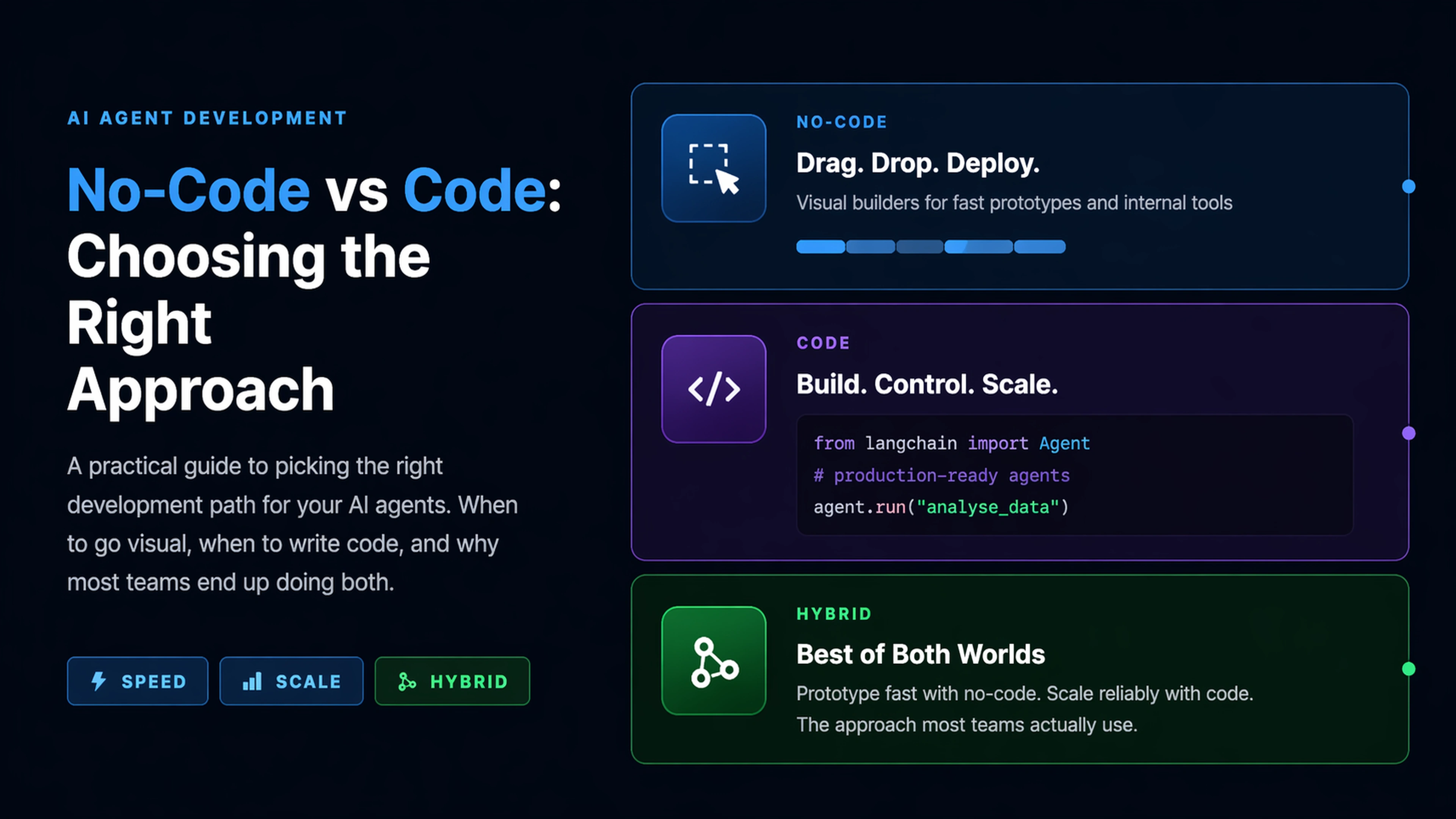
Almost every serious analysis of this space now points to a hybrid strategy. Not as a compromise, but as the genuinely best approach for most businesses.
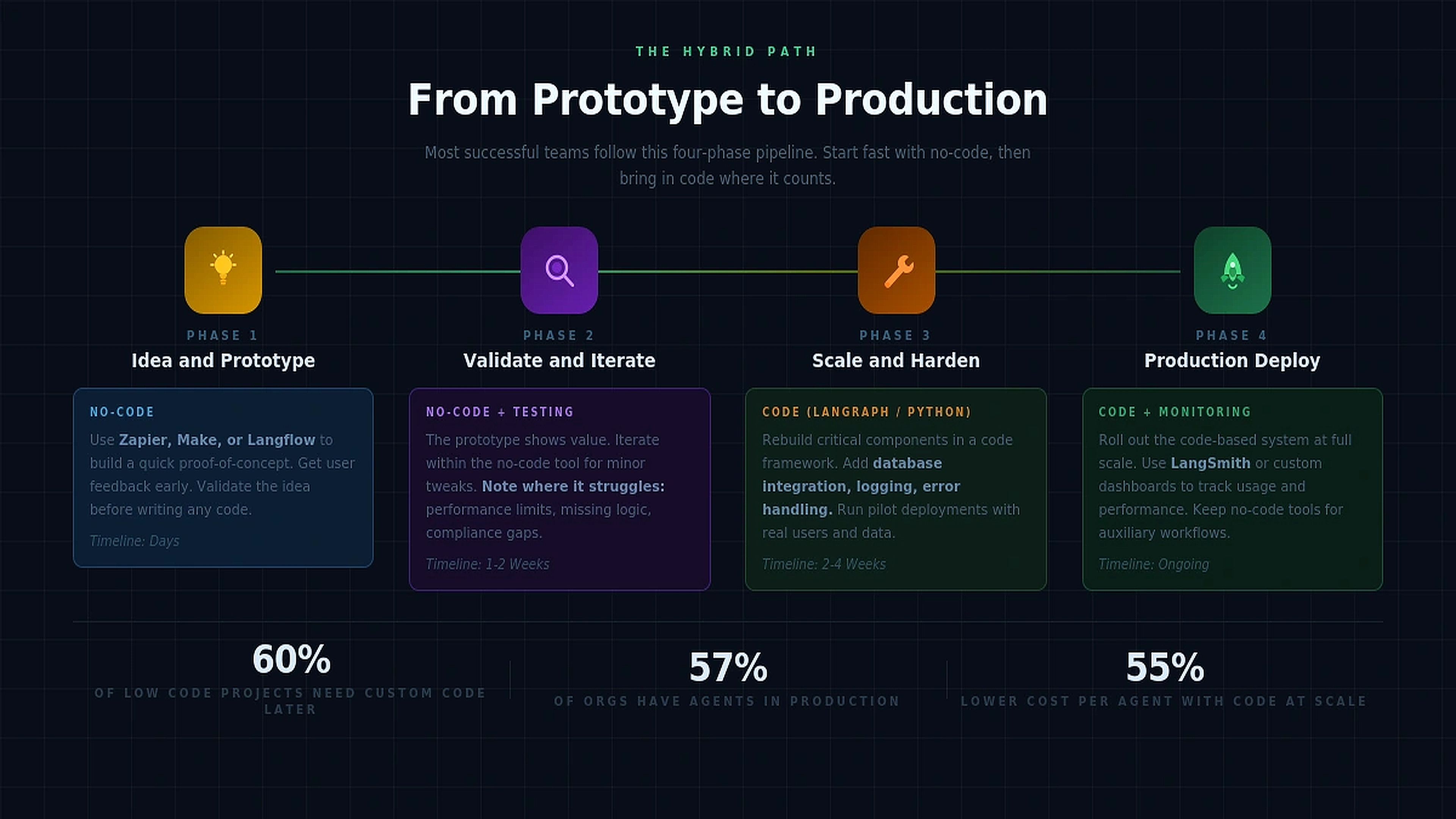
Hybrid AI Agent Development
Microsoft's Azure Architecture Blog lays out three paths: workflow-first for fast prototyping, code-first for complex orchestration, and hybrid for real-world deployments that need both speed and control. In practice, four patterns keep showing up:
- Prototype in no-code, build in code: Validate your idea in hours using Make, n8n, or Langflow. Once it proves valuable, rebuild in LangGraph or custom Python for production.
- No-code for simple flows, code for complex logic: Business users design triggers and routing visually. Engineers handle the custom reasoning and data processing underneath.
- Visual frontend, code backend: Tools like n8n let you drag and drop workflows while writing JavaScript or Python for the tricky parts.
- Mixed agents working together: Some agents built in no-code, some in code, all coordinating through shared protocols like MCP and Google's A2A standard.
Gartner estimates that 60% of organisations that start with low-code eventually need custom code. This is not a failure. It is the natural path. Prototype fast, identify bottlenecks, migrate critical parts to code, then scale with proper monitoring.
How to Choose Between No-Code and Code for AI Agents
When choosing the right approach, it helps to ground your decision in a few key factors. Start with your team's capabilities—who will build and maintain it. Then consider the complexity of the use case, expected scale, compliance requirements, and timelines. Whether you're aiming for a quick prototype or a long-term solution, balancing these elements ensures you make a practical, sustainable, and well-informed decision that aligns with both business goals and technical realities.
Use this table to quickly match your situation to the right approach:
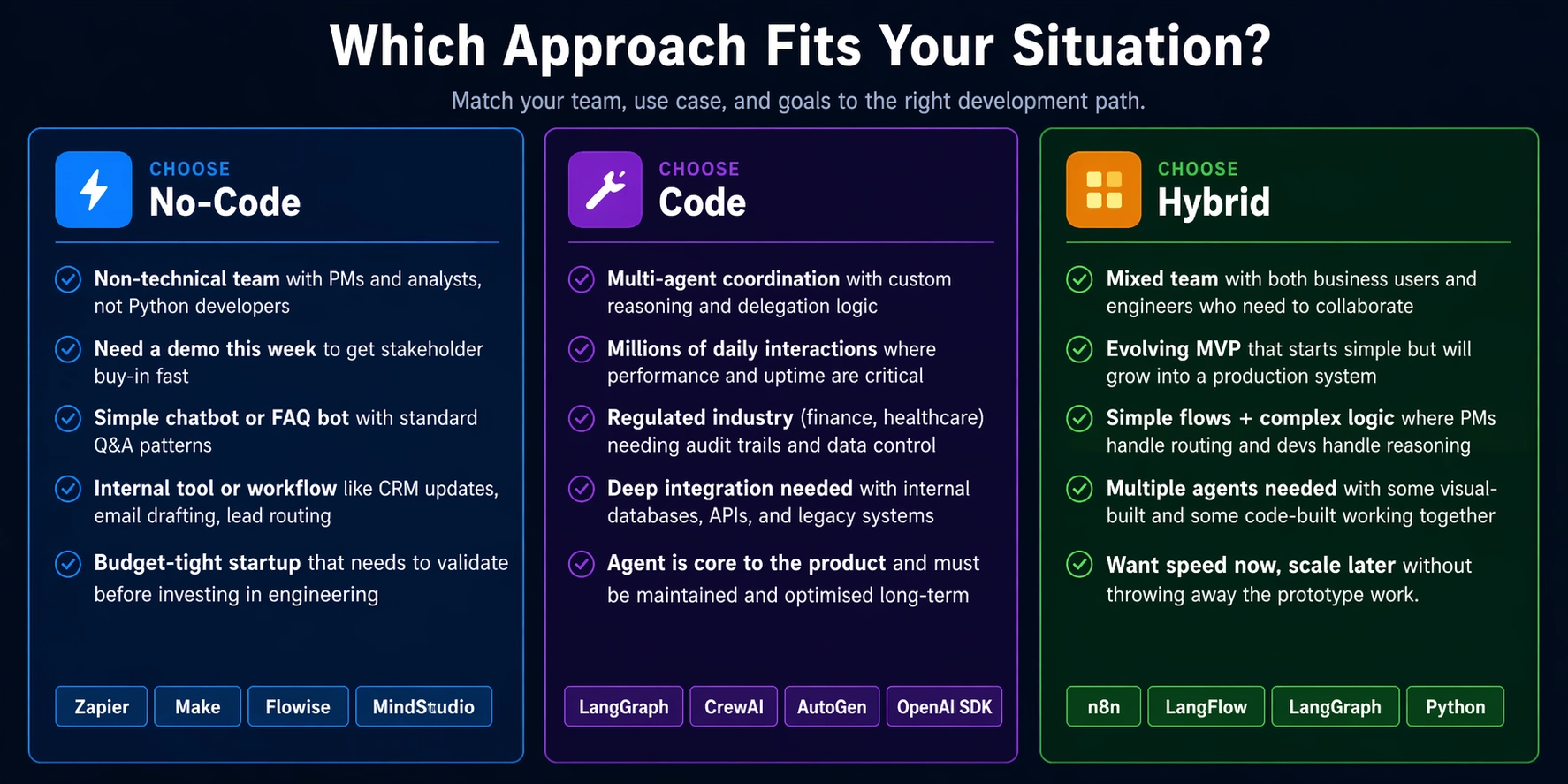
How to Choose Between No-Code and Code for AI Agents
Future of AI Agents: Trends to Watch in 2026 and Beyond
Multi-agent systems are the next big thing
Interest in multi-agent AI is growing rapidly, with businesses exploring how multiple AI agents can work together to handle complex tasks. By 2030, many organizations are expected to use these systems widely. This approach breaks work into smaller roles, helping teams improve efficiency, decision-making, and overall innovation.
No-code and code tools are blending
No-code tools are becoming more powerful by adding code-level AI capabilities. Platforms like n8n and Langflow now let users build advanced AI workflows visually, while still allowing code customization when needed. This shows how the gap between no-code and development is shrinking. In fact, experts predict that by 2026, many enterprise applications will include built-in AI agents, combining ease of use with flexibility, control, and scalability for businesses.
New interoperability standards are making agents work together
The industry is moving toward standard ways for AI agents to communicate and work together. New protocols like MCP and A2A are making it easier for agents to securely connect with data, tools, and even other agents across platforms. This means different AI systems can share context, coordinate tasks, and collaborate more effectively. The bigger vision is to create an "internet of agents," where specialized AIs can seamlessly work together across organizations, improving efficiency and unlocking new possibilities.
But let's be honest! Moving to production is still challenging. Despite rapid progress, scaling agentic AI isn't easy. Many projects show promise in early stages, but only a small percentage deliver real business impact. Most remain stuck in pilot mode. Turning a prototype into a reliable, production-ready system still demands strong engineering, continuous testing, proper monitoring, and clear governance to ensure performance, security, and long-term value.
Conclusion: Choosing the Right AI Agent Strategy
The no-code vs code debate is not about picking a winner. It is about using the right tool at the right stage. No-code platforms have gotten good. They can do much better than basic chatbots now. Code-based frameworks have also matured, giving developers powerful building blocks from the minimalist OpenAI Agents SDK to the full-featured LangGraph.
But the biggest takeaway from all the research, case studies, and industry data is simple: the hybrid approach is becoming the default. No-code gets you to a working product fast. Code takes you the distance.
So here is the practical advice: match your tools to your maturity. Start with no-code to prove value quickly. Then bring in code where it matters for scale, reliability, and control. Do not treat these as competing options. Treat them as stages in a journey.
Move fast. Then build to last.
FAQs