
table of content
- How Much Productivity Business Loose Due to Poor Knowledge Access?
- Is Microsoft Teams Creating More Confusion Than Clarity?
- What Is a Wiki-Based RAG Agent?
- Why Do Traditional Chatbots Fail in Enterprises?
- How Can a RAG Agent Improve Productivity and Decision-Making for Business?
- Faster Decision-Making at Every Level
- Dramatically Reduced SME Dependency
- Accelerated Onboarding and Time-to-Productivity
- Lower IT and Operations Support Overhead
- Institutional Knowledge Retention and Continuity
- Where Can a Knowledge AI Agent Be Used in Your Organization?
- HR & People Operations
- IT Support & Helpdesk
- Sales & Revenue Teams
- Operations & Process Management
- Leadership & Strategy
- Why Should You Build a RAG Agent Using Copilot Studio?
- How Much ROI Can a RAG Agent Deliver to Business?
- How Can You Future Proof Your Business with AI Knowledge Systems?
- Is Your Organization Ready for AI-Driven Knowledge Access?


Does Your Organization Need a knowledge AI Agent?
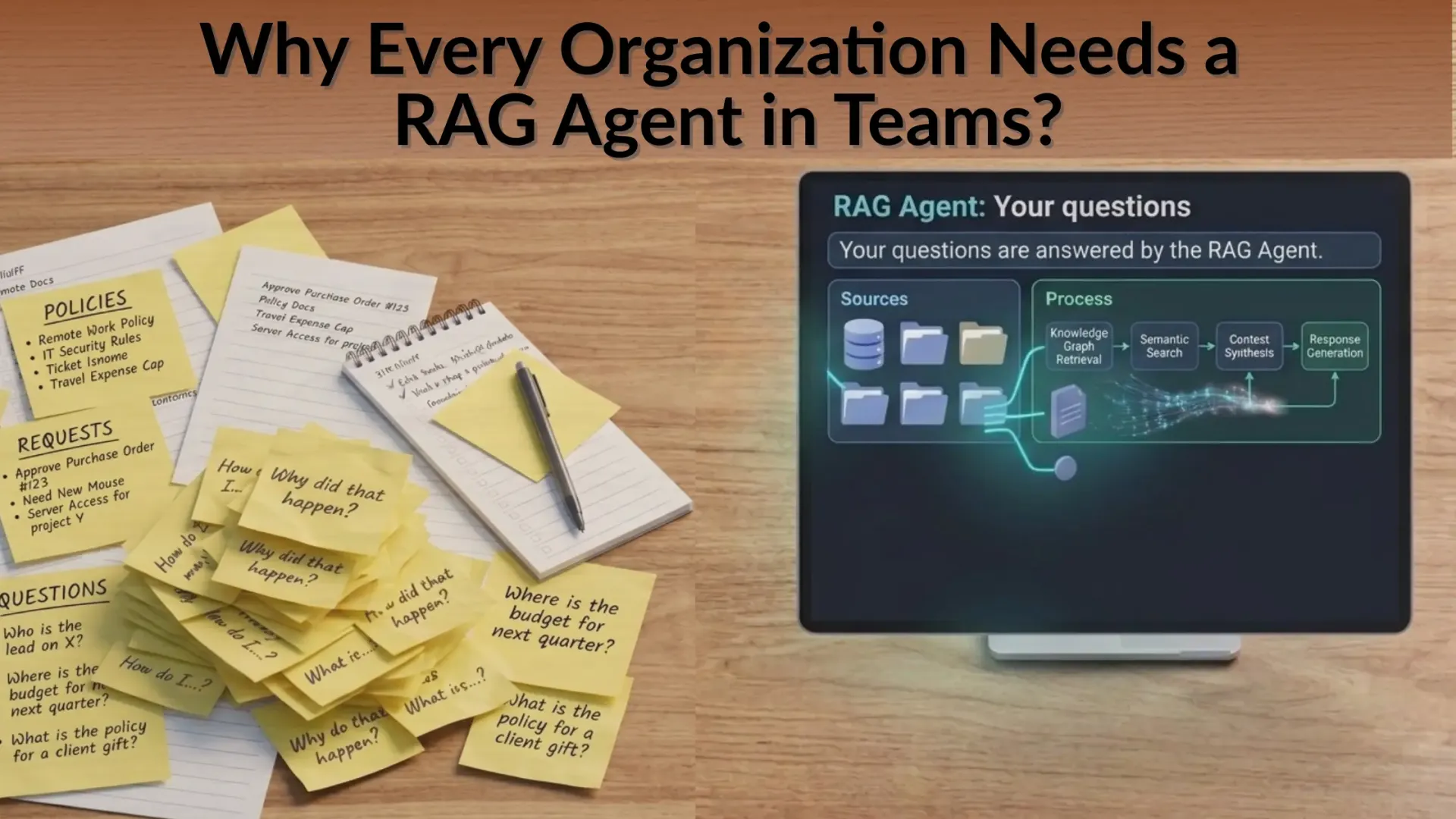
How Much Productivity Business Loose Due to Poor Knowledge Access?
Your employees are losing an average of 2.5 hours every day searching for information. That's according to IDC research, and if you run the math, that's over 30% of a typical workday spent not doing actual work. Multiply that by headcount, multiply it by salary, and you are looking at millions of dollars in lost productivity, silently draining your organization every single year.
Here is the uncomfortable question every leader needs to sit with: How much time does your team spend searching for Organizational answers instead of acting on them?
The problem is not that your people are not smart enough. It is that your knowledge is trapped in SharePoint folders, scattered across Teams channels, and locked inside the heads of your most experienced employees. As organizations scale, this problem persists. It compounds.
The good news? A new category of AI is solving this, and organizations that move first are building a structural competitive advantage that will be very hard to catch up to.
Is Microsoft Teams Creating More Confusion Than Clarity?
Microsoft Teams has become the digital headquarters for millions of organizations. It is where decisions happen, where projects live, and where communication flows. But here's the mystery: as Teams become more central, it also becomes more chaotic.
Think about what happens when a new employee joins and asks a simple question, "What is our process for client escalations?" They get pointed to a Teams channel. Then a SharePoint link. Then someone's inbox. Eventually, a 40-minute call with an SME who has 12 other things to do.
- Answers are inconsistent across departments.
- Critical procedures live only in someone's memory.
- New hires take months to become productive.
- Senior experts spend hours answering repeated questions, reducing their availability for priority tasks.
- Institutional knowledge walks out the door every time someone leaves.
Executive Insight
According to McKinsey, companies that improve knowledge sharing and accessibility can see a 20-25% increase in productivity. Yet most organizations are still relying on keyword search and human gatekeepers to manage their most valuable asset: what they know.
The Evolution of knowledge Retrieval
What Is a Wiki-Based RAG Agent?
RAG stands for Retrieval Augmented Generation. Let's understand this. Imagine hiring the world's best research assistant who has read every single document, wiki page, policy manual, and SOP your organization has ever written. When someone asks a question, this assistant doesn't guess. It goes into your actual knowledge base, retrieves the most relevant information, and constructs a precise, contextual answer instantly, in plain language.
A wiki-based RAG agent does exactly this, but it's connected directly to your internal wiki or knowledge management system. As your knowledge base grows and updates, the AI automatically works from the latest information. No manual retraining. No static FAQ lists. No outdated answers.
AI Transformation Tip
The key difference between a RAG agent and a regular chatbot is grounding. A regular bot generates answers from its training data. A RAG agent retrieves answers from your actual organizational knowledge, which makes it trustworthy, accurate, and enterprise ready.
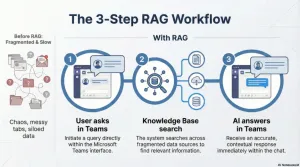
The 3-Step RAG Workflow
Why Do Traditional Chatbots Fail in Enterprises?
Over the past decade, businesses have deployed hundreds of traditional chatbots. Most of them are either abandoned, barely used, or actively avoided by employees. The reasons are consistent:
- They are built on static, manually curated content that goes stale within weeks.
- They can't handle nuanced or context-specific questions.
- Maintaining them requires ongoing technical effort and dedicated owners.
- They frustrate users with rigid, scripted response flows.
- They fail completely when questions fall outside their narrow training set.
The comparison table below shows why a wiki-based RAG agent is a fundamentally different proposition:
| Criteria | Traditional Chatbot | Wiki-Based RAG Agent |
|---|---|---|
| Knowledge Source | Static, pre-programmed FAQs | Live wiki & dynamic documents |
| Answer Quality | Keyword-match responses | Contextual and intelligent answers |
| Update Process | Manual reprogramming needed | Auto-syncs with wiki updates |
| Personalization | Generic responses | Role and context-aware replies |
| Scalability | Limited and rigid | Scales with organizational knowledge |
| Enterprise Fit | Low (breaks with complexity) | High (built for enterprise workflows) |
Traditional chatbots were built for simple and predictable queries. Enterprise knowledge management is anything but simple or predictable. That's why RAG agents represent such a significant leap forward.
How Can a RAG Agent Improve Productivity and Decision-Making for Business?
Faster Decision-Making at Every Level
When your teams can access accurate information in seconds rather than hours, decisions accelerate. A sales representative checking discount approval threshold, an operations manager verifying a process step, a Team leader validating policy before a client call, all these micro-decisions happen faster, with greater confidence. Speed compounds across an organization.
Dramatically Reduced SME Dependency
Your Subject Matter Experts are expensive, scarce, and overloaded. Right now, a significant portion of their time is consumed answering questions that already have answers and are documented somewhere, accessible to no one efficiently. A RAG agent empowers expertise by delivering SME-level answers on demand, at scale, around the clock. Your resources get their time back for doing actual expert work.
Accelerated Onboarding and Time-to-Productivity
The average employee takes 3-6 months to reach full productivity. A large percentage of that time is spent finding answers to questions they are afraid to ask or waiting for colleagues to help them navigate institutional complexity. A wiki-based RAG agent is available 24/7, never makes a new hire feel embarrassed for not knowing something, and can guide them through any process with precision. Organizations report significant improvements in onboarding speed when intelligent knowledge assistants are in place.
Lower IT and Operations Support Overhead
Tier-1 IT support tickets, HR policy inquiries, and process questions from operations, which states that a huge proportion of internal support volume is repetitive and answerable. When a RAG agent handles these consistently and accurately, your support teams get capacity back. They can focus on complex, high-value problems that genuinely require human judgment.
Institutional Knowledge Retention and Continuity
People leave. Restructuring happens. Tribal knowledge is the most fragile asset in any organization. A wiki-based RAG agent, connected to a well-maintained knowledge system, ensures that organizational intelligence persists regardless of personnel changes. It is the closest thing to making institutional memory permanent and universally accessible.
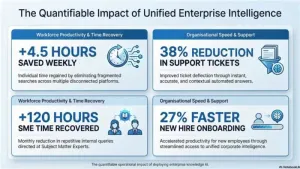
The quantifiable impact of unified enterprise Intelligence
Where Can a Knowledge AI Agent Be Used in Your Organization?
HR & People Operations
Employees constantly ask HR questions about anything related to benefits eligibility, leave policies, performance review timelines, and compliance requirements. A RAG agent handles all these instantly and consistently, which helps HR's administrative load while ensuring employees get accurate answers without waiting days for a response.
IT Support & Helpdesk
Common IT queries, such as how to set up VPN, how to request software access, password reset procedures, security compliance steps, etc., can be answered in seconds by a RAG agent. This deflects a massive volume of Tier-1 tickets, freeing your IT team for infrastructure, security, and strategic work.
Sales & Revenue Teams
Sales representatives in the field need fast answers for pricing structures, competitive battle cards, proposal templates, discount approval chains, and product specifications. A RAG agent embedded in Teams gives them instant access to current, accurate information, which instantly reduces pre-sales friction and improves conversion.
Operations & Process Management
From SOPs and compliance checklists to escalation protocols, operational teams live and die by process accuracy. A RAG agent ensures the right version of every procedure is always one conversation away, reducing errors and ensuring consistency across locations and teams.
Leadership & Strategy
Leaders often need quick context about the Q2 decision on a particular initiative, such as the current policy on international hiring, or the agreed KPIs for a business unit. A RAG agent gives leadership rapid and reliable recall across business history and current state, which helps executives in faster and sharper decision-making.
AI Transformation Tip
The highest-ROI deployments of wiki-based RAG agents focus on the top 20% of most-asked questions in your organization. Map your support tickets and recurring queries, and that's your deployment roadmap.
Why Should You Build a RAG Agent Using Copilot Studio?
Organizations that are already invested in Microsoft 365 have a significant head start. Microsoft Copilot Studio, which is formerly Power Virtual Agents, is a low-code platform that allows you to build, deploy, and manage AI agents directly inside Microsoft Teams without a separate toolchain or third-party integration to maintain.
Here's what makes Copilot Studio particularly compelling for enterprise leaders:
- Native Microsoft 365 integration: SharePoint, Teams, OneDrive, and your wiki are all connectable knowledge sources.
- Enterprise-grade security: It inherits your existing Microsoft tenant security, compliance, and data governance
- Low code build environment: It is accessible to IT, operations, and even informed business users without deep AI expertise
- Scalable and governed: full admin controls, usage analytics, and the ability to publish across your entire organization from a single governance layer
- Microsoft's ongoing AI investment: the platform gets better with every Microsoft AI development, meaning your investment appreciates over time
This isn't just about convenience. It's about strategic alignment. When your AI knowledge infrastructure is built on your existing Microsoft investment, you reduce cost, reduce risk, and accelerate the deployment timeline significantly compared to standalone AI solutions.
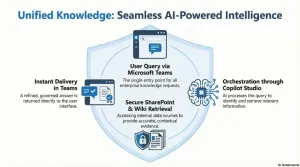
Seamless AI-Powered intelligence
How Much ROI Can a RAG Agent Deliver to Business?
The ROI of a wiki-based RAG agent isn't theoretical; it shows real operational metrics. Here's how enterprise leaders are framing the business case:
- Productivity recovery: If each employee saves even 30 minutes per day searching for information, across a 500-person organization, that's 125,000+ hours recovered annually
- Support ticket deflection: Organizations typically see a 30-50% reduction in repetitive internal support queries within the first 90 days of deployment
- Onboarding acceleration: New hire time-to-productivity improves materially when a 24/7 intelligent knowledge assistant is available from Day 1
- SME time recapture: Senior experts often recover 5-10 hours per week previously spent answering repeat questions, which time is redirected to high-value strategic work
- Knowledge retention value: The cost of re-learning and re-documenting knowledge lost through attrition is eliminated when knowledge is systematically captured and made accessible
Executive Insight
The competitive moat isn't the AI itself, but it's the organizational knowledge behind it. Companies that build strong, well-maintained knowledge systems and connect them to intelligent AI agents create an internal capability that is genuinely difficult for competitors to replicate. Knowledge compounds. The AI leverages it. The gap widens.
How Can You Future Proof Your Business with AI Knowledge Systems?
We are at an inflection point. The organizations that will lead their industries over the next decade are not necessarily those with the biggest budgets or most valuable staff. They are the ones who best leverage what they know and make that knowledge systematically accessible to every person on their team.
A wiki-based RAG agent in Copilot Studio is not a chatbot project. It is a knowledge infrastructure initiative. And like any infrastructure, which is a well-built road with a reliable network, its value grows with every person who uses it, every piece of knowledge added to it, and every decision made faster because of it.
The organizations that delay this transition are not standing still but falling behind after one lost knowledge asset, one slow decision, one frustrated new hire at a time.
Is Your Organization Ready for AI-Driven Knowledge Access?
The era of searching for information is ending. The era of conversational and intelligent knowledge access is here. And the tools to make this happen are a wiki-based RAG agent, built in Copilot Studio, deployed inside Microsoft Teams, which have never been more accessible, more affordable, or more strategically valuable.
The question for every CTO, CIO, and Operations Leader reading this is not whether your organization needs this capability. It is whether you will build it before your competitors do.
Ready to Transform How Your Organization Accesses Knowledge?
Start by auditing your top 20 most frequently asked internal questions. That's your first use case while being your first proof of value.
[Schedule a Knowledge Audit Session] [Explore Our RAG Agent Solutions]
FAQs
Q: What is a wiki-based RAG agent and how is it different from a regular chatbot?
A wiki-based RAG agent uses Retrieval Augmented Generation technology to search your actual organizational knowledge base before generating an answer. Unlike traditional chatbots, which rely on static, pre-programmed responses, a RAG agent retrieves and synthesizes information dynamically, delivering accurate, contextual, and up-to-date answers every time.
Q: Why should we build our RAG agent in Microsoft Copilot Studio specifically?
Copilot Studio integrates natively with your existing Microsoft 365 ecosystem. This means you can deploy an AI knowledge agent without introducing new security risks, new toolchains, or significant new costs. It also inherits your existing governance and compliance frameworks, which are critical for enterprise deployments.
Q: How does a wiki-based RAG agent in Teams impact employee productivity?
Research consistently shows employees spend 20-30% of their workday searching for information. A RAG agent dramatically reduces this time by delivering accurate answers in seconds, directly inside Teams. Across an organization, this time savings translates to significant productivity gains, faster decisions, and reduced SME dependency.
Q: Is this solution appropriate for non-technical leaders and small-to-mid sized organizations?
Absolutely. Microsoft Copilot Studio is built as a low-code platform, meaning business-aligned teams can configure and manage it without deep technical expertise. And the value of knowledge management AI scales down as well as even business of 50-100 employees sees significant productivity and knowledge retention benefits.
Q: What type of knowledge base works best with a RAG agent?
Any structured, maintained knowledge repository works well with Microsoft SharePoint wikis, Confluence, Notion, or even well-organized SharePoint document libraries. The quality of your RAG agent's answers is directly proportional to the quality and organization of your underlying knowledge base. This is also why building the AI agent is an excellent catalyst for organizations to invest in properly structuring their institutional knowledge.