
table of content
- Introduction
- Right Agentic AI Implementation Partner for Your Business
- What Is Agentic AI? What Are the Pros and Cons of Agentic AI?
- Advantages of Agentic AI for Businesses
- What Are the Signs Your Business Is Ready for Agentic AI?
- What Are the Most Common Challenges of Agentic AI Adoption?
- Is Your Business Ready for Agentic AI? Key Factors to Assess
- What Steps Should Businesses Take to Prepare for Agentic AI Adoption?
- How Do You Choose the Right Agentic AI Implementation Partner?
- Cost to develop applications over ReactJs and Next.Js
- The Final Words


Is Your Business Ready for Agentic AI?
Introduction
As businesses race to adopt Agentic AI, many are discovering that the technology itself is not the biggest challenge, but successful implementation is. While Agentic AI has the power to automate complex workflows, improve decision-making, and drive operational efficiency, businesses can only achieve these outcomes with the right expertise, strategy, and execution.
The difference between an AI project that delivers measurable business value and one that falls short often comes down to the implementation partner behind it. So, how do you identify the right Agentic AI service provider who can turn AI potential into significant business results?
From technical expertise and industry experience to scalability and long-term support, choosing the right implementation partner is a critical decision that can shape your organization’s AI journey for years to come.
What Is Agentic AI? What Are the Pros and Cons of Agentic AI?
Agentic AI is an advanced form of artificial intelligence that can autonomously plan, make decisions, and execute tasks to achieve specific business goals with minimal human intervention. Unlike traditional AI systems that primarily respond to prompts, Agentic AI can reason, adapt to changing conditions, interact with enterprise software, APIs, databases, and business applications, and take proactive actions to complete complex workflows.
By combining intelligence, automation, and decision-making capabilities, Agentic AI enables organizations to streamline operations, improve efficiency, and drive innovation at scale. As businesses continue to embrace digital transformation, Agentic AI is emerging as a powerful tool for enhancing productivity, optimizing resources, and delivering better customer experiences across industries.
Advantages of Agentic AI for Businesses
- Automates repetitive and time-consuming business processes.
- Makes autonomous decisions with minimal human intervention.
- Improves operational efficiency and productivity.
- Delivers faster responses through real-time data analysis.
- Adapts to changing business conditions and learns continuously.
- Scales easily to handle growing workloads and demands.
- Integrates seamlessly with enterprise tools, APIs, and databases.
Limitations of Agentic AI for Businesses
- Requires human oversight to minimize risks and errors.
- Depends heavily on high-quality and accurate data.
- Can introduce security, privacy, and compliance challenges.
- Implementation may require significant investment and integration efforts.
- Some AI-driven decisions can be difficult to explain or audit.
- May inherit biases present in training data.
- Requires clear governance and accountability frameworks.
What are the key Differences Between Traditional AI, Generative AI, AI Agent, and Agentic AI?
What Are the Signs Your Business Is Ready for Agentic AI?

Signs Your Business Is Ready for Agentic AI
As organizations face increasing pressure to improve efficiency, reduce operational costs, and scale faster, Agentic AI is emerging as a powerful solution. If your organization is experiencing any of the following challenges, it may be time to consider Agentic AI.
- Operational Bottlenecks Are Slowing Growth
- Business growth often stalls when teams are overwhelmed with routine work and unable to keep up with demand.
- Customer requests and support tickets are piling up.
- Opportunities are lost due to competing priorities.
- Teams struggle to provide personalized customer experiences.
- Critical workflows require excessive manual intervention.
- Employees Spend Too Much Time on Repetitive Tasks
- When skilled teams spend hours on low-value activities, productivity and innovation suffer.
- Teams spend critical time searching for information.
- Data entry, categorization, and task routing are handled manually.
- Meeting scheduling and follow-ups consume valuable work hours.
- Employees have limited time for strategic initiatives.
- Your Operations Cannot Scale Efficiently
- Manual processes often become barriers as business demands increase.
- Growing customer volumes overwhelm existing systems.
- Onboarding new customers or employees is slow and inconsistent.
- Service quality becomes difficult to maintain at scale.
- Operational costs increase as workload grows.
Agentic AI helps address these challenges by automating complex workflows, improving decision-making, and enabling scalable business operations.
What Are the Most Common Challenges of Agentic AI Adoption?
While Agentic AI offers significant business value, successful implementation requires organizations to address several operational, technical, and governance challenges. Understanding these obstacles can help businesses create a more effective Agentic AI adoption strategy.
- Data Quality and Data Readiness: Agentic AI depends on accurate, structured, and accessible business data to make informed decisions. Data silos, incomplete records, and poor data governance can reduce AI performance, limit automation capabilities, and impact business outcomes.
- Team Alignment and Change Management: Successful Agentic AI adoption requires employees and leadership to embrace new workflows. Resistance to change, lack of AI awareness, and concerns about job displacement can slow implementation and reduce organizational adoption rates.
- Technical Complexity and Skills Gap: Building, deploying, and maintaining Agentic AI solutions requires expertise in AI development, system integration, workflow orchestration, and prompt engineering. Many organizations face skill shortages that can delay implementation and increase project risks.
- Governance, Security, and Compliance: As Agentic AI systems make autonomous decisions, businesses must establish strong governance frameworks. Data privacy, cybersecurity, regulatory compliance, transparency, and bias mitigation are critical to ensuring secure, responsible, and trustworthy AI operations.
- Integration with Existing Systems: Many enterprises operate across multiple platforms, databases, and applications. Integrating Agentic AI with legacy systems can be complex, which will require careful planning to ensure seamless workflows, data consistency, and operational efficiency.
Is Your Business Ready for Agentic AI? Key Factors to Assess
Successful Agentic AI implementation requires more than advanced technology. Businesses must evaluate their strategy, data, processes, workforce, and governance to ensure they are prepared for scalable AI adoption and business transformation.
Strategic Alignment and Business Goals
Organizations should define clear business objectives before investing in Agentic AI. A strong AI strategy focused on measurable outcomes, operational efficiency, and ROI creates the foundation for successful digital transformation.
Leadership Commitment and Vision
Executive leadership plays a critical role in driving AI adoption. Business leaders must understand Agentic AI capabilities, align stakeholders, and establish a roadmap that supports enterprise-wide innovation and growth.
Data Readiness and Quality Management
High-quality, accessible, and well-governed data is essential for Agentic AI success. Poor data quality can limit AI accuracy, reduce automation effectiveness, and negatively impact business decision-making.
Process Optimization and Workflow Readiness
Before deploying AI agents, organizations should document, standardize, and optimize workflows. Agentic AI delivers the greatest value when automating efficient business processes rather than reinforcing existing operational inefficiencies.
Technology Infrastructure and Architecture
Modern cloud infrastructure, scalable systems, API integrations, and orchestration frameworks are critical for Agentic AI. Organizations relying on legacy technology may need modernization to support autonomous workflows.
Change Management and Organizational Readiness
Employees must be prepared to collaborate with AI agents. Effective change management, AI training, and workforce enablement programs help increase adoption, reduce resistance, and improve business outcomes.
Governance, Security, and Risk Management
As AI autonomy increases, businesses need strong governance frameworks. Security controls, compliance policies, human oversight, transparency, and risk management practices ensure responsible and trustworthy AI deployment.
Workforce Skills and AI Expertise
Agentic AI requires professionals with expertise in AI development, automation, data management, prompt engineering, and system orchestration. Upskilling employees strengthens long-term AI capabilities and competitiveness.
Cost Management and ROI Tracking
Organizations should establish cost management processes to monitor AI investments. Tracking operational costs, performance metrics, and business value helps maximize ROI and support sustainable Agentic AI adoption.
What Steps Should Businesses Take to Prepare for Agentic AI Adoption?
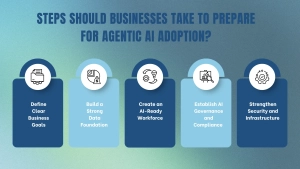
Successfully implementing Agentic AI requires more than deploying modern technology. Businesses need a structured Agentic AI adoption strategy that aligns business objectives, data readiness, workforce capabilities, governance frameworks, and operational scalability.
Step 1: Define Clear Business Goals
Identify the business challenges Agentic AI will solve, whether improving customer service, automating workflows, or increasing productivity. Establish measurable KPIs and success metrics to ensure your AI implementation delivers tangible business value and ROI.
Step 2: Build a Strong Data Foundation
Agentic AI depends on high-quality, accessible, and well-governed data. Consolidate data sources, eliminate silos, improve data quality, and establish data governance practices to support accurate AI-driven decisions and workflow automation.
Step 3: Create an AI-Ready Workforce
Prepare employees for AI adoption through training, upskilling, and change management initiatives. Building AI literacy across teams helps improve collaboration between employees and AI agents while accelerating organizational adoption.
Step 4: Establish AI Governance and Compliance
Develop policies for AI security, transparency, accountability, and regulatory compliance. Strong AI governance frameworks help mitigate risks, reduce bias, protect sensitive data, and ensure responsible AI deployment.
Step 5: Strengthen Security and Infrastructure
Secure enterprise systems, APIs, databases, and AI models against cyber threats. A scalable technology infrastructure ensures Agentic AI solutions can operate reliably while supporting business growth and digital transformation.
Step 6: Start Small and Scale Strategically
Begin with pilot projects focused on high-impact business processes. Measure results, optimize performance, and gradually expand successful Agentic AI initiatives across departments to maximize efficiency and long-term business outcomes.
How Do You Choose the Right Agentic AI Implementation Partner? w
Agentic AI has the potential to transform how businesses operate, but success depends on more than just choosing the right technology. To get real value from Agentic AI, you need a partner who understands your business goals, existing processes, and the practical challenges of implementation.
The right implementation partner can help you identify the best use cases, integrate AI into your systems, and ensure that your solution is secure, scalable, and aligned with your business objectives. Instead of focusing only on technology, they should focus on delivering outcomes that improve efficiency, productivity, and customer experiences.
When evaluating an Agentic AI partner, consider the following:
- Proven AI and Automation Experience: Look for a team with hands-on experience building intelligent business solutions.
- Strong Understanding of Your Industry: Industry knowledge helps create more effective and relevant AI workflows.
- Integration Expertise: The partner should be able to connect Agentic AI with your existing applications, data, and business processes.
- Scalability and Flexibility: Choose a solution that can grow and adapt as your business evolves.
- Security and Compliance: Data protection and responsible AI practices should be a top priority.
- Customization Capabilities: Every business is different, and your AI solution should reflect that.
- Ongoing Support and Optimization: Continuous improvements are essential to maximize long-term value.
You should also consider a partner experience in AI Automation solutions and Cloud Migration services, as these capabilities often play a key role in building a solid foundation for Agentic AI success.
At CodeStore, we help businesses turn Agentic AI ideas into practical, results-driven solutions. Our team combines expertise in AI, automation, cloud technologies, and custom software development to create solutions that fit your unique business needs. Whether you are just starting your AI journey or looking to scale existing initiatives, CodeStore can help you move forward with confidence.
The Final Words
Agentic AI is rapidly changing how businesses operate by enabling smarter automation, faster decision-making, and more efficient workflows. However, successful adoption requires more than technology alone; it demands the right strategy, data foundation, governance, and implementation expertise.
Organizations that assess their readiness, address potential challenges, and partner with experienced providers will be better positioned to unlock the full value of Agentic AI. As technology continues to evolve, businesses that take a proactive approach today can gain a significant competitive advantage and build a more agile, intelligent, and future-ready organization.
FAQs